Global warming has now reached unprecedented levels, posing severe challenges to human survival and development. Previous research has shown that six of nine planetary boundaries have been exceeded, indicating that Earth is now well outside of the safe operating space for humanity. Against this backdrop, providing scientific, equitable, and practical approaches for calculating the carbon quotas and responsibilities of a country has become crucial to achieving the temperature goals of the Paris Agreement and global carbon neutrality.
On March 2, Professor Li Jianping, a Level I Distinguished Professor under the “Zhufeng” Scholars Program at Ocean University of China (OUC), proposed a framework for national carbon quotas and climate debt based on equal environmental human rights (EHRs). Under this framework, he established a set of quantitative indicators, including remaining carbon emission quota (RCEQ), mandatory carbon neutrality time (MCNT), and cumulative atmospheric extra warming, with the aim of clarifying each country’s carbon permit allocation (CPA), carbon neutrality time, and corresponding “climate debt” under the 2°C threshold and the 2050 global carbon neutrality initiative. He also introduced a dynamic national EHRs index that objectively assesses a country’s environmental human rights status. This framework provides a new quantitative basis for global climate governance and also scientifically demonstrates that China’s 2060 carbon neutrality goal is highly consistent with scientific estimates. As the sole author of the study, Professor Li’s article was published in Climate Dynamics under the title “Carbon permit allocation, carbon neutrality time and climate debt for one country under equal environmental human rights”.
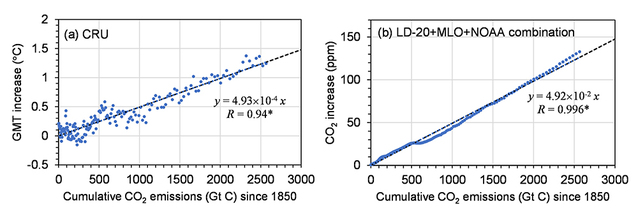
Grounded in the right to a clean, healthy, and sustainable environment, formally recognized by the United Nations General Assembly in 2022, the study argues that national emission space and climate responsibilities should be defined within a framework of equal environmental human rights (EHRs). To systematically analyze carbon responsibility, the study proposes a hierarchical framework of three-level carbon permit allocation (CPA) and corresponding climate debt. The primary CPA focuses on the cumulative carbon emissions (from fossil fuels and land-use change) from production processes. The principle for it is the equity principle of EHRs, and the corresponding primary climate debt is emission debt. The secondary CPA tracks the embodied carbon transfer from trade and consumption processes. The principle for it is the consumption fairness, and the corresponding climate debt is consumption debt. The tertiary CPA is due to the damage from the negative environmental effects of the countries whose cumulative carbon emissions have exceeded their CPAs. The principle for it is the sustainable development fairness, and the corresponding climate debt is adaptation debt. This study mainly addresses the primary level of CPA and climate debt for one country. By establishing a quantitative relationship between cumulative emissions and warming, it provides a scientific basis for equal EHRs. The results show that global warming is driven by cumulative carbon emissions: it is highly linearly correlated with the increase in global mean surface air temperature (GMT) and atmospheric CO2 concentration. Each 1000 Gt C of cumulative CO2 emissions is assessed to likely cause a 0.49 °C increase in GMT, slightly higher than the 0.45 °C reported in the IPCC AR6, and a corresponding 49.2 ppm increase in atmospheric CO2 concentration.
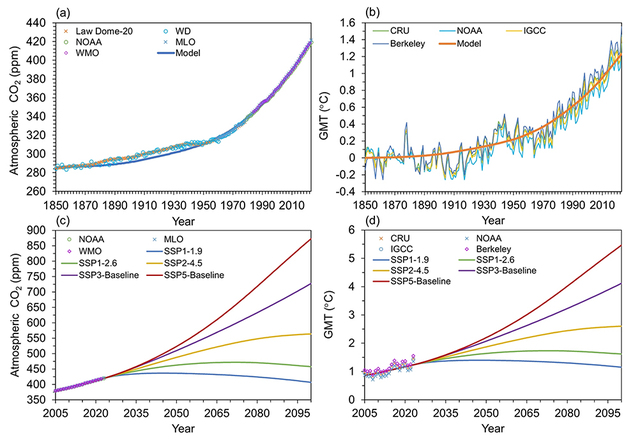
On the theoretical level, the study develops a simple climate-carbon model (CCM) to describe the response of the climate to anthropogenic cumulative carbon emissions. Numerical experiments show that the model effectively simulates the historical changes in the atmospheric CO2 concentration and temperature. This provides a scientific foundation for allocating carbon quotas under the principle of equal EHRs.

Based on the 2 °C warming threshold and the 2050 global carbon neutrality initiative, the study further introduces a new carbon accounting system, the EPC (an equal per capita carbon quota under equal EHRs), with the aim of eliminating inter-regional and intergenerational differences. It is assessed that as of 2022, the USA, Canada, Russia, the UK, Germany, and Australia (C6 for short) no longer have any allowable carbon emission space, their total carbon emission deficits are up to 656.15 Gt C, and their MCNTs are 1936, 1928, 1959, 1966, 1966, and 1988, respectively. This means that these countries had already exhausted their equitable shares long ago and should bear responsibility for their excess emissions. In comparison, China’s RCEQ is 423.23 Gt C, and its MCNT is 2061, indicating that China’s commitment to achieving carbon neutrality before 2060 is fully in line with scientific estimates. The findings also show that although at present China is the world’s largest annual carbon emitter, from the perspective of EHRs, it still has a lot of room for permissible carbon emissions. On the contrary, the C6 countries are currently not the countries with the highest annual carbon emissions, but they have exceeded their shares and should shoulder the corresponding climate responsibilities.
The study further points out that once a country’s carbon emissions exceed the limits allowed under EHRs, it generates additional warming and damage, thereby incurring “climate debt”. At present, the USA alone has contributed about 0.194 °C of cumulative atmospheric extra warming, accounting for about 49% of the global total, while the C6 countries together have contributed about 0.328 °C, 82% of the total. This has seriously undermined the EHRs of other countries, especially developing countries. Calculated at US $90 per tCO2, as of 2022, the cumulative climate debts of the USA and C6 have reached as high as about US $ 34.9 and 59.1 trillion, respectively.
It is worth noting that land use also plays an important role in addressing climate change. The study innovatively introduces the LF index, the ratio of cumulative land-use changes CO2 emissions (ELUC) to cumulative fossil CO2 emissions (EFOS). Data analysis shows that, among developed countries with RCEQ surpluses, 100% have an LF index of less than 1, indicating that measures such as forestation have effectively enabled carbon sink functions in these economies. By contrast, in most developing countries with RCEQ deficits, their LF index is greater than 1, suggesting that activities like deforestation contribute to carbon emissions. These findings provide scientific support for the “two mountains theory” that lucid waters and lush mountains are invaluable assets, highlighting its values in global climate governance.
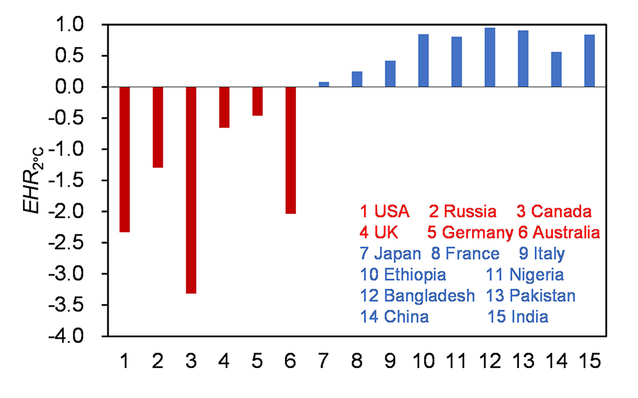
To objectively assess whether a country has exceeded its globally equal share of EHRs and its degree of deterioration, the study proposes a dynamic national EHRs index. This index eliminates intergenerational and regional differences, dynamically tracks the EHRs status of each country, and translates abstract equity principles into concrete numerical values. When the index is positive, it indicates that its EHRs situation is sound and its climate impact is within its legitimate rights and interests. When the index is negative, it indicates that the country has encroached upon additional environmental benefits, caused cumulative atmospheric extra warming, and experienced serious deterioration in its EHRs situation. As of 2022, China’s national EHRs index remained strongly positive, whereas all C6 countries have significant negative indices. Among them, the USA had the largest negative value, indicating that its excess emissions had caused the greatest extra warming and the most severe deterioration in EHRs. This index is not merely a statistical indicator, but also a key bridge linking scientific facts (emissions and warming), ethical principles (EHRs), and political responsibilities (climate debt and MCNT), providing strong quantitative support for advancing global climate justice.
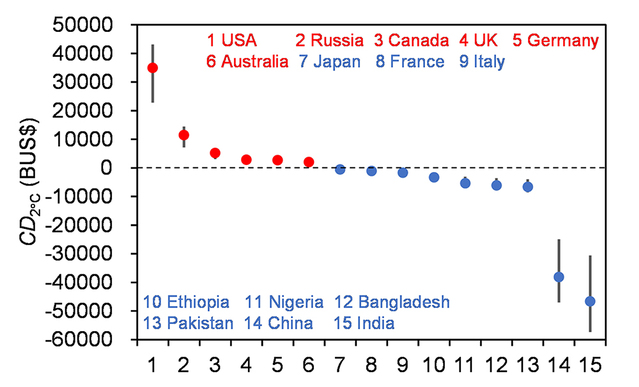
The study also points out that the current scale of global climate finance falls far short of actual climate debt. At COP29, a New Collective Quantified Goal on climate finance of at least US $300 billion per year by 2035 was set. However, compared with the cumulative climate debt of at least US $59.1 trillion that developed countries should repay, this amount is clearly far from sufficient. Future global climate governance must establish a fair burden-sharing mechanism based on scientifically assessed climate debt to truly achieve climate justice.
The study further critiques the one-sided practice found in much international research of defining climate responsibility solely based on carbon emission volumes. Such an approach overlooks EHRs, reasonable carbon quotas, population factors, the fundamental human rights to survival and development, emissions from land use change, historical responsibility, the different roles of producers and consumers, and differences in development stages. Simply attributing historical extreme climate responsibility to major emitters or countries with high emissions is scientifically unfounded and unfair.
This study provides global climate governance with an accounting tool that combines scientific rigor with fairness. It proposes a practical and updatable method for calculating national climate debt, offering a scientific basis for international climate negotiations, the Loss and Damage Fund mechanism, the allocation of climate finance, and the design of carbon neutrality pathways, which is of great significance for advancing the goals of the Paris Agreement and promoting climate justice.