On February 20, a research team led by Professor Dong Bo from the Fang Zongxi Center for Marine Evo-Devo, Ocean University of China (OUC), published their latest findings online in Science Advances as a research article entitled “Taurine-Driven Chemotaxis and Metamorphosis in Ascidian Tadpole Larvae”.
Aiming to address the heavy attachment of invasive biofouling organisms on port infrastructure and marine aquaculture facilities, the research team drew inspiration from the high-density colonization of ascidians on scallop culture cages and proposed that farmed scallops may contain chemotactic factors that attract ascidian larvae. Through a series of screening and analytical experiments, the researchers identified taurine, which is present in both scallop and ascidian tissues, as the chemical cue that attracts ascidian larvae. Further experiments showed that taurine specifically stimulate primary sensory neurons within larval papillae, and this neuronal excitation is integrated in the central nervous system, thereby eliciting larval behavior including settlement and metamorphosis. Taurine is a free amino acid abundant in marine economic animals such as scallops and oysters, where its content is several hundred times higher than in terrestrial organisms. It has diverse functions in regulating physiology, such as regulating tissue osmolarity and enhancing neural conduction and excitability, and is therefore used as an important ingredient in some energy and anti-fatigue drinks. Taurine is the first environmental chemical signaling molecule identified that induces ascidian larval settlement. This finding not only helps explain the high-density attachment of marine fouling organisms, but also provides an important scientific basis for the development of targeted antifouling technologies against ascidian by interfering with larval chemosensation. The study also offers a new perspective for research in the field of marine Eco-Evo-Devo.
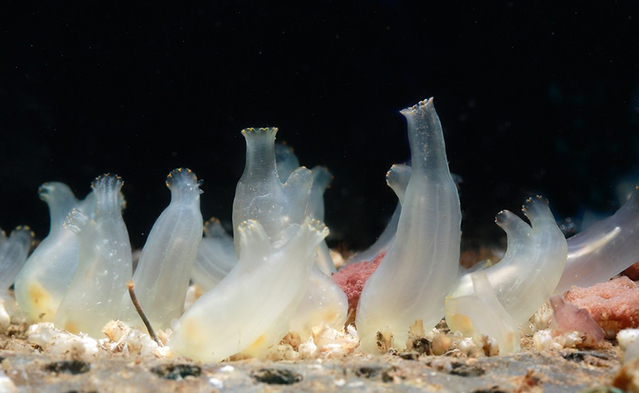
Most marine invertebrates undergo metamorphosis to transit from a planktonic larval stage to a benthic or sessile adult form. Settlement and metamorphosis at sites with suitable environmental conditions are crucial for the successful establishment and expansion of the adult populations, but often give rise to ecological problems such as bioinvasion and biofouling. Therefore, understanding how marine larvae locate suitable places for metamorphosis, feeding, growth, and reproduction is essential for addressing marine ecological challenges such as bioinvasion and biofouling. Chemosensation represents one of the most fundamental sensory functions across all living organisms, which allows them to distinguish between environments that contain desirable or deleterious chemical cues. Although how marine larvae perceive environmental signaling molecules to shape their communities has long received widespread attention, studies on the underlying sensory mechanisms and behaviors remain relatively limited.
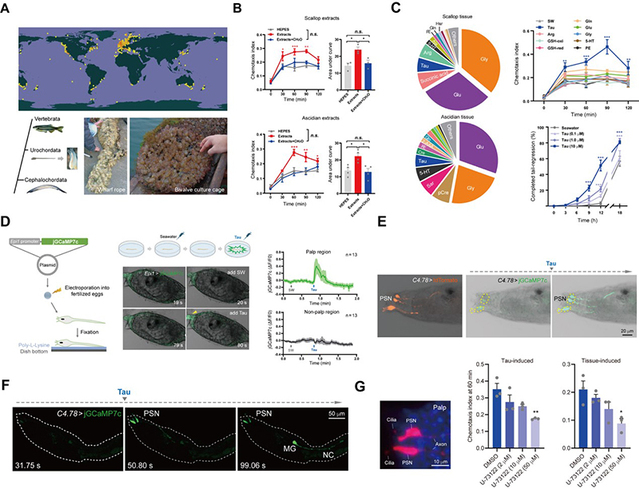
In this study, researchers use the typical coastal fouling organism, the ascidian Ciona savignyi, as a model to explore how chemosensation influences ascidian settlement preferences. Through laboratory chemotaxis bioassays, they found that tissues from cultured bivalves and adult ascidians contain chemical substances that attract ascidian larvae and induce settlement and metamorphosis. By combining mass spectrometry analysis of tissue extracts with chemotaxis-based screening, they identified taurine, which is abundant in both bivalve and adult ascidian tissues, as a chemical attractant and metamorphic inducer for ascidian larvae. To further explore how ascidian tadpole larvae perceive this environmental chemical cue, the researchers conducted in vivo real-time calcium imaging to monitor the excitation of epidermal sensory cells before and after taurine stimulation. They constructed an epidermis-specific calcium sensor, jGCaMP7c, and electroporated it into fertilized ascidian eggs. After developing into larvae, researchers observed that taurine-evoked calcium transients occur exclusively in a subset of cells within papillae at the most anterior regions of the larval trunk. By further analyzing and screening the three cell types in the papillae, the team demonstrated that primary sensory neurons (PSNs) directly perceive taurine and relay neuronal excitement to the motor ganglion and nerve cord within the larval central nervous system. The process linking chemosensation to larval behavioral output relies on the distribution of gonadotropin-releasing hormone (GnRH) signaling.
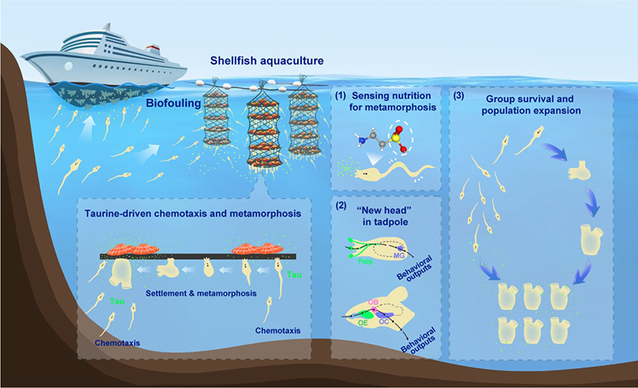
By elucidating the mechanisms underlying chemosensation and behavioral regulation in ascidian larvae, this study presents an Eco-Evo-Devo research model for studying marine larval behaviors and developmental regulation from an ecological and evolutionary perspective. The identification of taurine and the elucidation of its neural perception mechanism not only deepens our understanding of how marine larvae adapt to their environment but also opens the door to the development of antifouling techniques to alleviate economic losses in aquaculture.