On February 9, Professor Zhang Yuzhong’s team from the College of Marine Life Sciences, the MOE Key Laboratory of Evolution and Marine Biodiversity, and the Frontiers Science Center for Deep Ocean Multispheres and Earth System at Ocean University of China (OUC), in collaboration with Professor Jonathan D. Todd from the University of East Anglia, published their latest findings in The EMBO Journal under the title “Regulation of DMSP organosulfur cycling in ubiquitous Roseobacter marine bacteria”.
Marine organisms produce more than 8 billion tons of dimethylsulfoniopropionate (DMSP) annually. As the most abundant organosulfur compound produced in the oceans, the catabolism of DMSP drives marine sulfur biogeochemical cycling and also influences global climate through the production of climate-cooling gas dimethylsulfide (DMS). As ubiquitous heterotrophic marine bacteria, many Roseobacters possess two competing metabolic pathways for DMSP catabolism: the demethylation pathway and the cleavage pathway, with only the cleavage pathway producing DMS. The coordinated regulatory mechanism between the two pathways had long remained unclear.
Using the model Roseobacter Ruegeria pomeroyi DSS-3, the researchers confirmed through multidisciplinary approaches that the FadR-type transcriptional regulator DmdR serves as the core “switch” controlling DMSP catabolism. When DMSP levels are low, DmdR binds to the dmd box sequences at the dmdA-acuI promoter, thereby repressing the expression of genes involved in demethylation (dmdA), cleavage-pathway detoxification (acuI), and oxidative stress protection (dmdEF, dinB). This allows DMSP to accumulate intracellularly and perform its protective, antistress functions. When DMSP levels rise to the millimolar range, the cytotoxic cleavage product acryloyl-CoA accumulates and binds to DmdR, resulting in a conformational change that releases it from the DNA-binding site. This relieves the transcriptional repression of relevant genes, enabling cleavage pathway detoxification, increasing catabolic flux through the demethylation pathway, and activating the oxidative stress protection system.
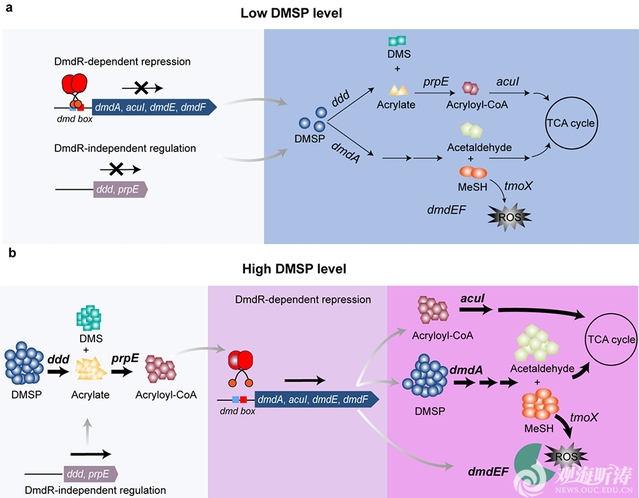
This study is the first to elucidate the coordinated regulatory mechanism governing the two competing DMSP metabolic pathways in marine Roseobacters. It reveals the molecular basis by which marine bacteria respond to changes in DMSP concentration and balance stress protection with catabolic utilization, filling a key gap in understanding the regulatory mechanisms of marine DMSP catabolism and providing important evidence for clarifying the link between marine sulfur cycling and global climate change.
Professor Zhang Yuzhong and his team have long been engaged in research in marine microbiology and microbial oceanography, and in recent years have reported a series of important advances on element cycles driven by marine microorganisms, including the cycles of carbon, nitrogen, phosphorus, and sulfur. The findings now reported in The EMBO Journal represent another new advance for the team in the fields of marine microbiology and microbial oceanography.