On October 31, 2025, a research team led by Academician Bao Zhenmin and Professor Wang Shi from the MOE Key Laboratory of Marine Genetics and Breeding at Ocean University of China (OUC) published an article entitled “Ocean-M: an integrated global-scale multi-omics database for marine microbial diversity, function and ecological interactions” in Nucleic Acids Research, formally presenting the global-scale multi-omics database Ocean-M.
Marine microbial communities are essential drivers of ocean ecosystem functioning and the global biogeochemical cycle, helping to maintain the balance and health of the Earth’s ecosystems. Microorganisms in extreme environments offer unique insights into adaptation mechanisms and clues about the origins of life. Beyond that, marine microorganisms also harbor a vast reservoir of bioactive compounds, offering great potential for innovative applications in marine resource development, environmental pollution control, and biotechnology. The rapid increase of meta-omics data in public repositories presents unprecedented challenges in data integration and in-depth analysis. Existing databases are largely designed as repositories of data resources and analytical tools, and they generally lack systematic mining and deep interpretation of heterogeneous, multi-source data. How to achieve the systematic integration of complex, high-dimensional, and large-volume microbial datasets, and to move from analyses focused on single species to comprehensive, multi-dimensional ecological-niche perspectives, remains a key challenge. To address this challenge, the research team developed the Ocean-M platform and built an integrated global-scale multi-omics database for marine microorganisms. Ocean-M overcomes the limitations of conventional databases and establishes an integrated platform for in-depth research that links omics resources, ecological interactions, and functional gene mining.
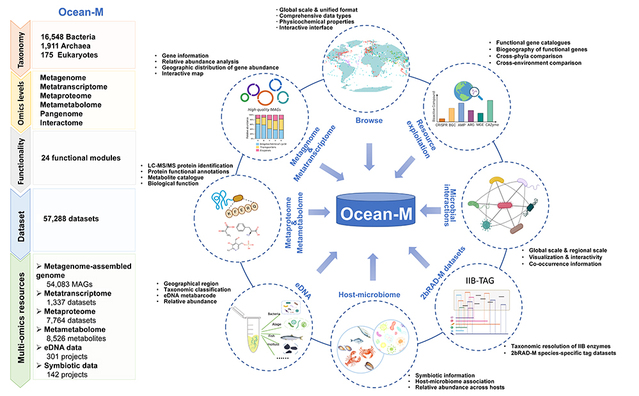
Ocean-M integrates global-scale marine microbial multi-omics data across diverse habitats and spatial scales, and has become the most comprehensive open-access database in the field of marine microbiology. The platform consolidates over 57,000 datasets of marine microbial communities from different ocean ecosystems worldwide, spanning multiple omics layers, including metagenomics, metatranscriptomics, metaproteomics, and meta-metabolomics, covering ecological gradients from polar to equatorial regions and from surface waters to the deep sea. With unified data processing pipelines and standardized identifiers, Ocean-M provides the largest collection of marine metagenome-assembled genomes (MAGs) to date, offering a systematic view of more than 50,000 representative microorganism genomes. These resources support global-scale visualization and analysis of microbial community structure, functional traits, and spatial distribution. Ocean-M functions as a comprehensive interactome framework based on hologenome data, integrating microbial community networks, host-microbiome interactions, and environmental DNA datasets. This integrated framework enables precise characterization and flexible querying of microbial community structure, functional traits, and their ecological-niche interrelationships, supporting full-dimensional analyses of ecological interactions and providing new perspectives and tools for ecological research. At the same time, Ocean-M implements a tri-layered analytical framework that links “genomes-genomic functions-ecological preferences”. Through large-scale mining of functional genes, the platform has built curated catalogs comprising millions of functional genes, providing powerful support for functional gene discovery and the elucidation of ecological system functions. In addition, building on the previously developed 2bRAD-M approach for high-resolution taxonomic profiling of marine microbial communities, the team has constructed a curated 2b-RAD tag library, which can resolve over 95% of microbial species, offering an effective solution for precise identification and classification of microorganisms in complex marine environments. Ocean-M not only provides strong data support for basic research in marine microbiology and ecology, but also offers a valuable data resource for marine biological resource development and biotechnological innovation.