On October 30, 2025, undergraduate student Cai Renjun, under the supervision of Associate Professor Chen Long and Professor Li Sanzhong from the MOE Key Laboratory of Submarine Geosciences and Prospecting Techniques at Ocean University of China (OUC), published an article entitled “Andesite formation dominated by inefficient fractional crystallization of andesitic melt: Insights from melt inclusions” in Earth and Planetary Science Letters. This study reports new progress on the genesis of andesite in oceanic subduction zones.
Andesite is a characteristic lithology in oceanic subduction zones, particularly in continental arcs, with chemical compositions resembling the continental crust, and is therefore a key proxy for studying crustal formation and evolution. However, the dominant mechanism for andesite formation remains debated. Classical models propose that andesite is generated either by fractional crystallization of basaltic melts or by mixing between mafic and felsic magmas, yet these models cannot simultaneously explain the complex mineral textures, geochemical characteristics, and crustal structure beneath volcanic arcs.
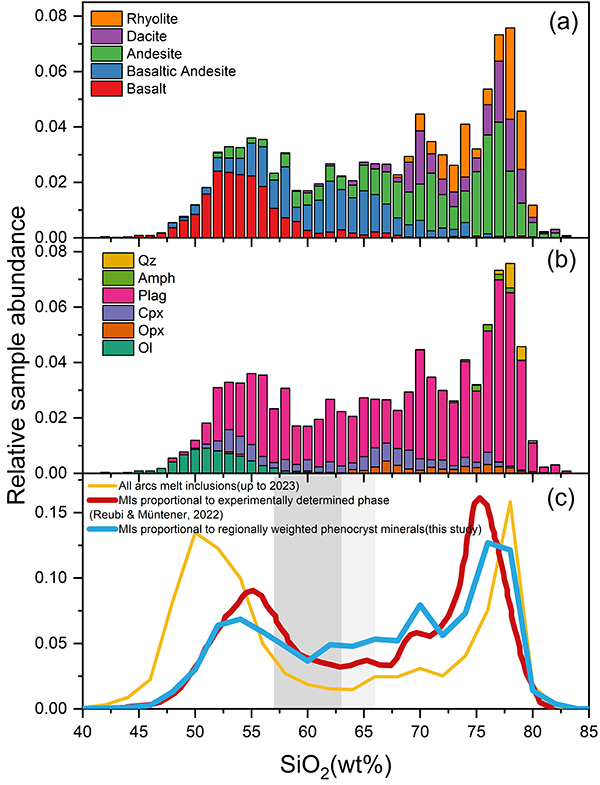
Melt inclusions are small parcels of melt trapped in minerals during crystal growth. They preserve compositional data from various magmatic stages, acting as “liquid snapshots” of melt development. Previous work suggested that the SiO2 contents of melt inclusions in arc volcanic rocks exhibit a bimodal distribution, apparently supporting magma-mixing models. However, some researchers pointed out that this bimodal distribution may result from sampling bias and could instead be more consistent with fractional crystallization models. To address this, the research team recalibrated and systematically analyzed melt inclusion data from arc volcanic rocks by weighting them according to the natural proportions of different lithologies in arc volcanic suites and the composite abundances of phenocryst minerals in each rock type.
The study found that the recalibrated melt inclusion data no longer exhibit a bimodal SiO2 distribution, but instead cluster around a single high-SiO2 felsic peak. In basalts and rhyolites, melt inclusions generally match the SiO2 contents of their host rocks, whereas inclusions in andesites and dacites are systematically more silica-rich than their hosts. Equilibrium melts calculated from amphibole and clinopyroxene phenocrysts in andesites are generally more enriched in trace elements than the corresponding host rocks, but closely resemble the compositions of melt inclusions. These results indicate that most melt inclusions are cogenetic with their host minerals and that they respectively represent residual melts and co-crystallized crystals, rather than products of heterogeneous magma mixing.
On this basis, the authors propose a new model for the genesis of andesites in oceanic subduction zones. In this model, metasomatized mantle wedge rocks enriched in recycled crustal materials (such as pyroxenite) undergo partial melting to produce primitive andesitic melts. During the evolution of these andesitic melts, their relatively high viscosity and the small density contrast between crystals and melt hinder efficient crystal settling and separation, resulting in inefficient fractional crystallization. Crystals are repeatedly remixed with the residual melt, ultimately forming andesite. The model outlines a complete evolutionary pathway for arc andesites controlled by inefficient fractional crystallization and phenocryst-melt self-mixing. It explains both the abundance of phenocrysts and the disequilibrium structures in andesites, and also reveals the fundamental origin of their relatively evolved geochemical characteristics.
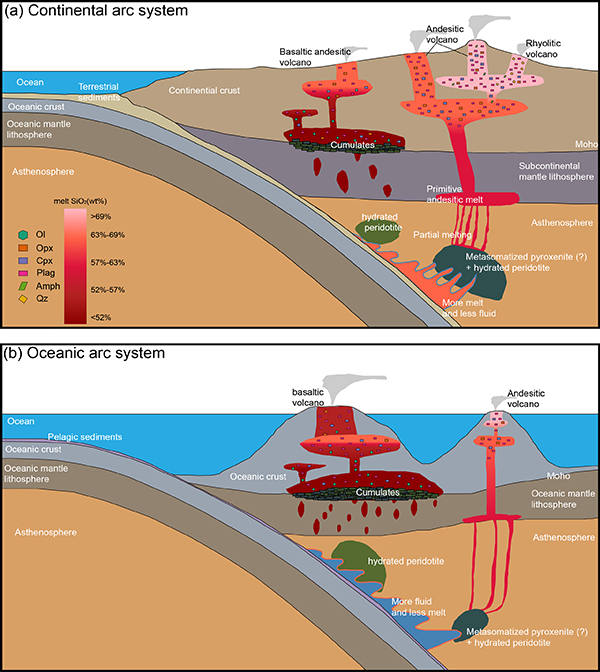
In addition, this study helps resolve three long-standing paradoxes in conventional basalt differentiation models: (1) the predicted but rarely observed large volumes of ultramafic cumulates in the arc lower crust, (2) the high-MgO content in many andesites (high-magnesium andesite), and (3) the apparent inconsistency between natural observations, which require andesite compositions to reflect high-pressure differentiation, and experimental results showing that high-pressure fractional crystallization tends to generate peraluminous intermediate melts, whereas most natural andesites are metaluminous.
The result represents an important breakthrough in understanding the genesis of andesite in oceanic subduction zones. Since Bowen proposed the theory of fractional crystallization on the basis of experimental petrology in the 1920s, conventional models have generally regarded andesite as being derived from basaltic parent magmas through fractional crystallization or magma mixing. However, these models overlook the fact that experimental petrology can only demonstrate crystallization, whereas efficient crystal-melt separation is largely an idealized assumption. The inefficient fractional crystallization model proposed in this study not only integrates the two classical end-member models of fractional crystallization and magma mixing, but also provides a coherent framework for andesite formation that links primitive processes with magmatic evolution. This innovative perspective is of profound significance for understanding subduction-zone magmatic processes and geodynamics, providing new constraints on the rates of continental crust growth and destruction in subduction zones.