On January 21, a research team led by Professor Zhuang Guangchao from the Frontiers Science Center for Deep Ocean Multispheres and Earth System and the MOE Key Laboratory of Marine Chemistry Theory and Technology at Ocean University of China (OUC), working with collaborators in China and abroad, published an article entitled “Atmospheric deposition enhances marine methane production and emissions from global oceans” in Nature Communications. The team has made new progress in marine methane biogeochemistry by systematically revealing a new mechanism through which atmospheric deposition regulates marine methane production and emissions.
Methane (CH4) is a potent greenhouse gas whose warming effect is more than 20 times that of CO2. Reducing global methane emissions is therefore an important means of advancing climate governance and achieving carbon neutrality goals. The ocean is one of the sources of atmospheric methane, releasing approximately 6–12 Tg CH4 to the atmosphere each year. As an important source of nutrient inputs to the surface ocean, atmospheric deposition significantly influences upper-ocean biogeochemical cycling; however, the mechanisms by which it affects marine methane production and emissions remain unrecognized.
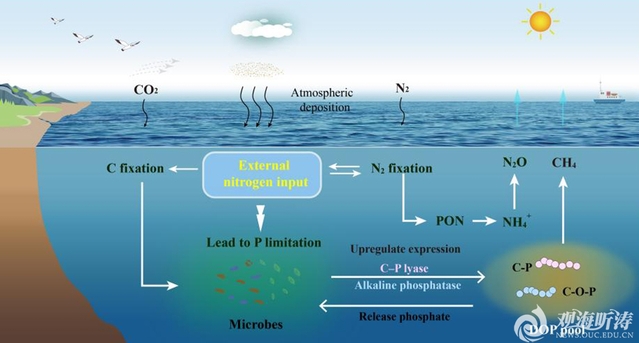
In this study, the research team focused on the aerobic methane production pathway driven by methylphosphonate (MPn) degradation in the oxygenated surface ocean. Under phosphorus-limited conditions, microorganisms can degrade MPn to obtain bioavailable phosphorus, with methane produced as a by-product during cleavage of the carbon-phosphorus (C-P) bond. Combining multidisciplinary approaches, including in situ observations, incubation experiments, bioinformatic analyses, and machine-learning approaches, the team found that excessive atmospheric nitrogen (N) deposition markedly increases the nitrogen-to-phosphorus (N:P) ratio in surface seawater, intensifies phosphorus limitation, and thereby enhances MPn degradation by microorganisms and the associated methane release. Building on this, they integrated global surface-ocean metagenomic datasets and environmental databases, used a random forest regression (RFR) method to construct and predict the global distribution patterns of key genes involved in C-P bond cleavage pathways, and quantitatively estimated the impacts of atmospheric N deposition on marine methane production and emissions.
The results show that atmospheric N inputs increase the abundance of key genes involved in C-P bond cleavage pathways in the global surface ocean by 12.5-18.6%, and that elevated N:P ratios can lead to a marked increase in surface-ocean methane production rates. Approximately, an increase of 0.22 Tg in surface methane emissions caused by atmospheric N deposition to the global ocean would be achieved over the period of 2025-2050, accounting for 14.3%-33.3% of the annual amount of methane released from the open ocean. These results indicate that by altering nutrient stoichiometry, atmospheric deposition can enhance the production and release of marine methane, thereby partly offsetting its contribution to oceanic carbon sequestration and revealing more complex feedbacks among atmospheric deposition, nutrient cycling, and greenhouse-gas production in the ocean.
This study is the first to propose and verify the core mechanism linking “atmospheric N deposition—nutrient imbalance—microbial phosphorus metabolism—marine methane production and emissions”, further deepening current understanding of atmospheric deposition and the biogeochemical cycling of marine greenhouse gases. The research was conducted jointly by OUC and multiple partner institutions, including the University of Georgia.