On January 23, a research team led by Professor Zhang Zhengguang of the State Key Laboratory of Ocean Dynamics-Physical Environment and Intelligent Sensing at Ocean University of China (OUC) published their latest findings in Nature Communications in an article entitled “Extreme rainfall over land exacerbated by marine heatwaves”. This study is the first to demonstrate that marine heatwaves can substantially exacerbate extreme rainfall over land, and it reveals the physical mechanisms underpinning this linkage.
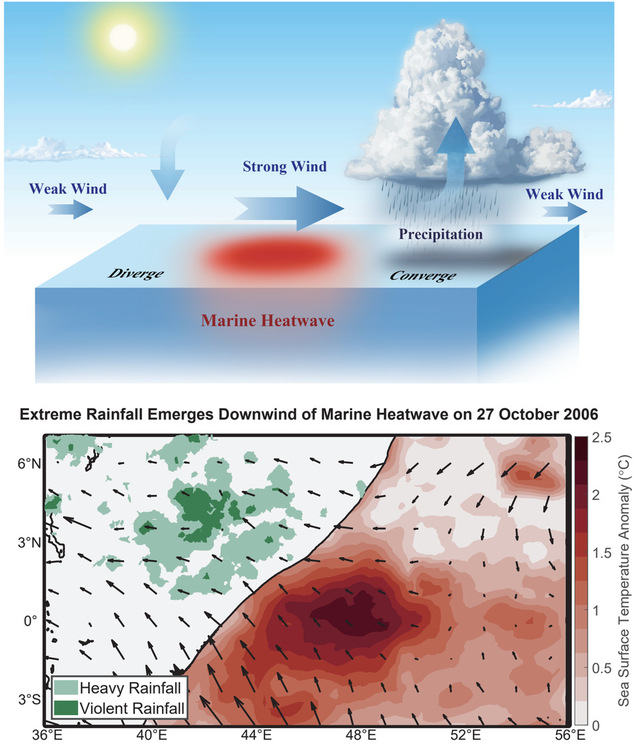
Against the backdrop of global warming, extreme events in the climate system are becoming more intense, frequent, and complex, thereby increasing the risk of major losses to human society. Marine heatwaves (MHWs), as extreme ocean-warming events, are projected to increase markedly in frequency, intensity, and duration under continued global warming; however, their influence on extreme rainfall, especially those over land, and the underlying mechanisms have remained poorly understood. By analyzing atmospheric responding signals to mesoscale heat spots embedded within MHWs using global multi-platform observational datasets, the team found that MHWs mainly affect atmospheric precipitation through a vertical mixing mechanism. These mesoscale heat spots, with horizontal scales of about 100-150 km, are local maxima of sea surface temperature (SST) characterized by sharp SST gradients. Such gradients enhance vertical turbulent momentum flux in the marine atmospheric boundary layer, accelerating surface winds over warm waters, inducing surface wind convergence, and strengthening moisture convergence and upward motion. As a result, precipitation is substantially enhanced in the downwind region of these mesoscale heat spots.
In global coastal regions, about 5%–25% of extreme rainfall events are within the influence range of nearby MHWs. Averaged land precipitation of the extreme rainfall events in the downwind direction of a strong MHW increases by 20%-30%, significantly increasing flood risk. Consistently, a 30% increase in the fatalities and missing persons caused by floods located in the downwind direction of a MHW is observed, comparing with floods free of a MHW influence. Under ongoing global warming, coastal regions are among the areas where MHW intensity is increasing most rapidly, implying a sustained rise in the risk of extreme rainfall over land. These findings provide a scientific basis for disaster prevention and mitigation in coastal regions.