Chemosynthetic symbiosis, a common form of host-microbe association in marine ecosystems, is typically found in extreme environments such as deep-sea hydrothermal vents and cold seeps. However, the mechanisms of chemosymbiosis and its ecological role in shallow water, organic-rich sediments remain understudied. On March 4, a team led by Professor Sun Jin from the Institute of Evolution & Marine Biodiversity at Ocean University of China (OUC), in collaboration with a team led by Professor Zhuang Guangchao from the Key Laboratory of Marine Chemistry Theory and Technology of the Ministry of Education, published an article entitled “Intricate chemosymbiosis in a widespread shallow-water thyasirid clam” in Science Advances.
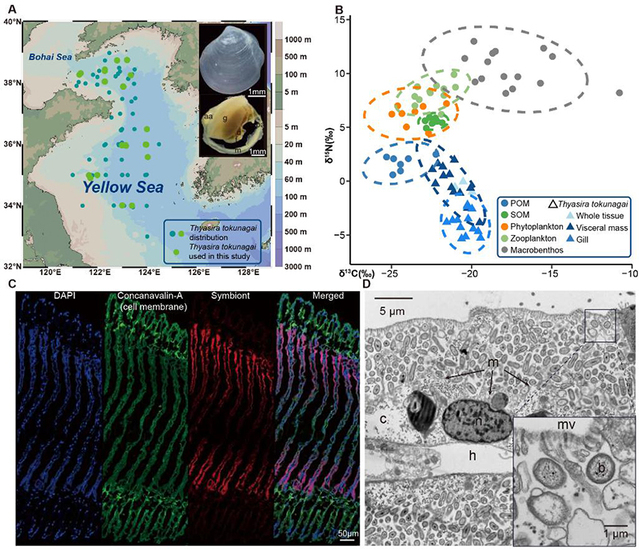
Extensive ecological surveys on the microbenthic fauna in the Yellow Sea since 1958 have consistently shown that Thyasira tokunagai—a constituent of the T. gouldii complex—is one of the dominant species, especially in the cold water mass area of the northern Yellow Sea. Members of the bivalve family Thyasiridae inhabit diverse environments, including deep-sea hydrothermal vents, cold seeps, and hadal environments, and are known to harbor chemosymbiotic bacteria. Therefore, whether the widely distributed T. tokunagai in the Yellow Sea also exhibits chemosymbiosis, as well as the diversity of its symbionts, their chemosynthetic pathways and rates, and their contribution to regional biogeochemical cycling, has remained an important scientific question.
To address these questions, the teams led by Professors Sun Jin and Zhuang Guangchao at OUC, together with multiple collaborating institutions, formed an interdisciplinary research team. Over 6 years, drawing on samples collected during 9 shared research cruises, the team carried out a systematic investigation of Thyasira tokunagai from the sediments in the cold water mass area of the Yellow Sea. By integrating multiple approaches, including stable isotope analysis, fluorescent in situ hybridization, electron microscopy, gene amplicon sequencing, metagenomics, metatranscriptome sequencing, spatial metabarcoding analysis, and 14C-labeled DIC tracing, the researchers established a comprehensive research framework encompassing morphological observation, multi-omics analysis, and quantitative assessment.
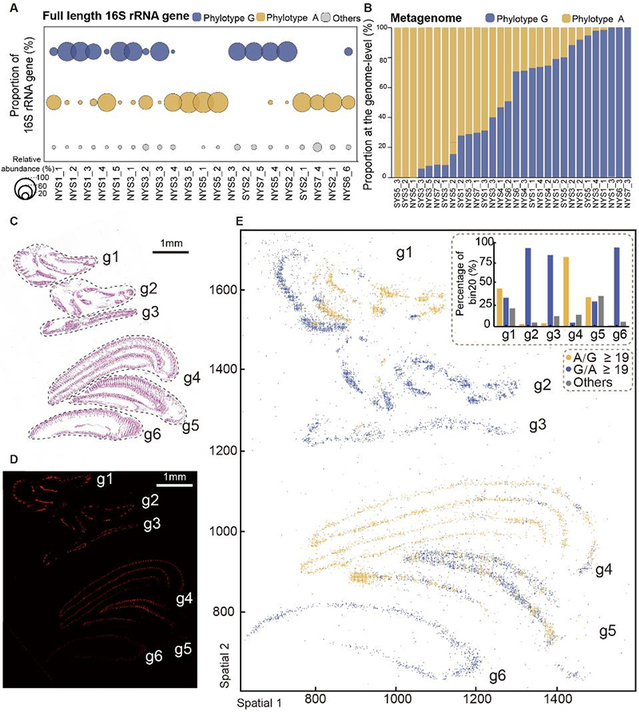
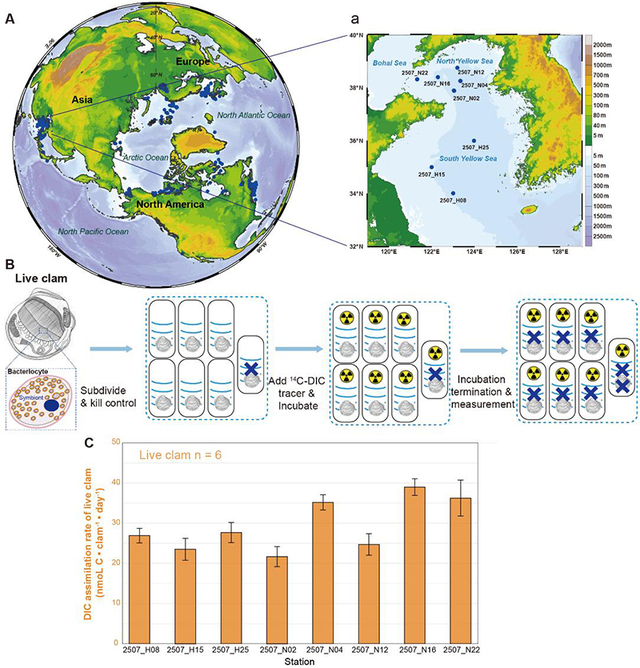
The study yielded several major findings. Two symbiont phylotypes of the same Sedimenticola species made up the bacterial population in the gill tissues of T. tokunagai, forming a stable symbiosis through an exocellular symbiotic mode. There was only a single base pair difference (G versus A) between these two phylotypes at the 590th position of the 16S rDNA, and they showed pronounced spatial heterogeneity, while remaining highly conserved in genomic content and core metabolic potential, and exhibited close-knit host-symbiont metabolic integration. Functional analyses revealed that the symbionts can utilize sulfide in the microhabitat of the host as an energy source and fix inorganic carbon through the Calvin cycle, thereby producing organic compounds, amino acids, vitamins, and other nutrients that can be utilized by both the symbiont and the host. The host, on the other hand, adopts mixotrophic strategies that combine deposit feeding with chemosymbiosis, enabling complementary and efficient nutrient acquisition. Furthermore, by developing an in situ environmental simulation approach for the live holobiont and combining it with high-sensitivity 14C-labeled DIC tracing, the team quantified the average carbon fixation rate of the live T. tokunagai as 29.3 ± 8.7 nmol C·clam−1·day−1. The carbon fixation capacity of a single clam is thus approximately comparable to that of 370 ml of the surrounding seawater. Based on these measurements, and using Kriging interpolation, the annual carbon sink of the T. tokunagai population in the Yellow Sea was estimated at approximately 2.74 Gg C·yr-1, providing key quantitative evidence for understanding carbon cycling in shallow-water ecosystems.
This study elucidates the chemosymbiotic mechanism of shallow-water thyasirid clams, reveals a new mode of host-symbiont metabolic cooperation in shallow-water environments, and helps fill a major knowledge gap in research on shallow-water chemosymbiosis. With its wide distribution, abundant populations, and ease of handling, Thyasira tokunagai provides a new model for marine chemosymbiosis research. Its substantial carbon fixation capacity further suggests that shallow-water chemosymbiotic organisms may be underestimated contributors to marine carbon sinks, offering an important supplement to our understanding of biogeochemical cycling in shallow-water ecosystems.