On January 26, a research team led by Professor Zhang Juncheng from the College of Physics and Optoelectronic Engineering, Faculty of Information Science and Engineering, Ocean University of China (OUC), published their latest findings in Advanced Materials in an article entitled “Dual-Window Broadband Near-Infrared Mechanoluminescence in MgO-Based Phosphors”. In this study, the authors systematically investigated the near-infrared mechanoluminescence behavior of MgO-based phosphors and analyzed the mechanisms of luminescence modulation and their physical origins.
Mechanoluminescence (ML) refers to the phenomenon in which materials emit light in response to mechanical stimuli, such as friction, compression, or stretching. It essentially involves the direct conversion of mechanical energy into light energy and is of great significance for stress-state characterization, structural condition monitoring, and biomechanical studies. Compared with visible light, near-infrared (NIR) emission features weaker scattering, lower background interference, and stronger penetration through biological tissues, so NIR ML materials have attracted increasing attention in recent years. However, previous studies have shown that most NIR-I ML materials remain constrained by narrow emission bandwidths and reliance on dark-field conditions, whereas many NIR-II materials rely on specific luminescent centers or complex energy-transfer processes, and their emission efficiency and stability still need to be further improved. These issues have, to some extent, limited a systematic understanding of their underlying physical mechanisms.
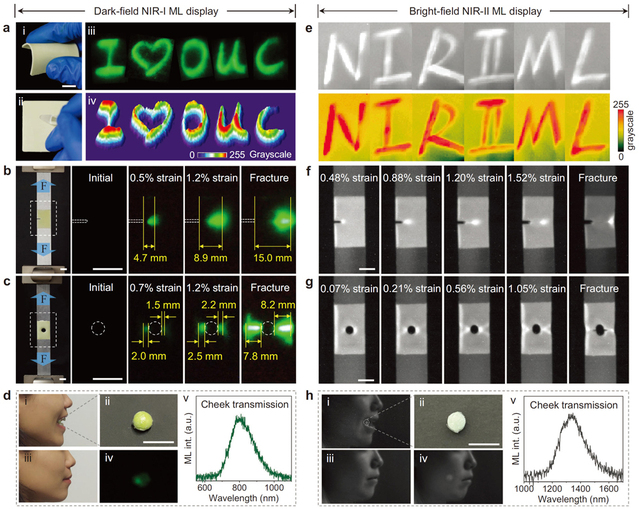
Addressing these issues, the team developed two complementary MgO-based ML material systems with Cr³⁺and Ni²⁺ ions as luminescent centers and carried out systematic experiments on their luminescence behavior under different mechanical stimuli. The results show that Cr³⁺-doped MgO exhibits stable NIR-I ML emission (700–1000 nm) under a variety of mechanical actions, including friction, impact, stretching, compression, bending, and twisting, and that the emission bandwidth can be continuously tuned by adjusting the Cr³⁺ doping concentration. In contrast, Ni²⁺-doped MgO displays ultrabroadband NIR-II ML emission spanning 1000–1700 nm and can be directly detected under ambient lighting conditions. Mechanistic analysis indicates that the ML process arises from the synergistic interplay of local piezoelectric polarization, dislocation-mediated charge separation, and triboelectric effects at the organic–inorganic interfaces, while the observed changes in the emission spectra are closely related to crystal-field modulation and lattice distortions. Further co-doping experiments compared the luminescence behavior under photo- and mechanical-excitation conditions, revealing distinct energy-conversion pathways for different excitation modes and providing experimental evidence for understanding mechano-to-photon conversion mechanisms in centrosymmetric oxide systems. Building on this, the research team carried out demonstrations under both dark-field and bright-field conditions, visualizing stress distributions and biomechanical processes via NIR ML and further verifying the detectability and stability of these materials under complex environmental conditions.