On October 23, 2025, a research group led by Professor Xu Xiaofeng from the Department of Polymer Materials and Engineering, School of Materials Science and Engineering at Ocean University of China (OUC), published an article entitled “Tailor-Made Solar Desalination and Salt Harvesting from Diverse Saline Water Enabled by Multi-Material Printing” in Advanced Materials.
Freshwater scarcity remains a pressing global challenge that threatens the sustainable development of human society. In recent years, solar-powered interfacial evaporation has attracted growing interest owing to its sustainability and low energy consumption, and has shown unique advantages in the desalination and resource recovery of high-salinity brines. Aerogels, hydrogels, and foams are common photothermal materials, yet their isotropic 3D structures produced by conventional fabrication constrain the optimization of photothermal performance and the integration of multiple functions. Additive manufacturing (3D printing) is an effective approach for fabricating materials with intricate 3D geometries. Nevertheless, photothermal composites produced by existing 3D printing technologies still suffer from issues such as monotonous pore structures, energy loss, mass-transfer resistance, and difficulties in controlling salt crystallization, making it challenging to achieve stable seawater desalination and resource recovery under high-salinity conditions.
In this study, multi-material direct ink writing (DIW) 3D printing was used to precisely deposit diverse photothermal inks at designated spatial locations, thereby constructing 3D photothermal matrices with gradient architectures. Synergistic engineering of ink formulations, cation-modulated cross-linking networks, printing fidelity, hierarchical porosity, and matrix integration enables tunable composition, structure, and function, yielding solar interfacial steam generators (3D SGs) and solar crystallizers (3D SCs) with high performance in solar desalination, solute separation, and salt harvesting across a broad salinity range (3.5–25%). This work demonstrates, for the first time, the use of multi-material 3D printing to flexibly fabricate photothermal composites with customizable shapes and functions that not only achieve higher evaporation rates in seawater than in freshwater but also operate stably under high-salinity conditions, realizing solar-driven desalination and resource recovery from concentrated brines.
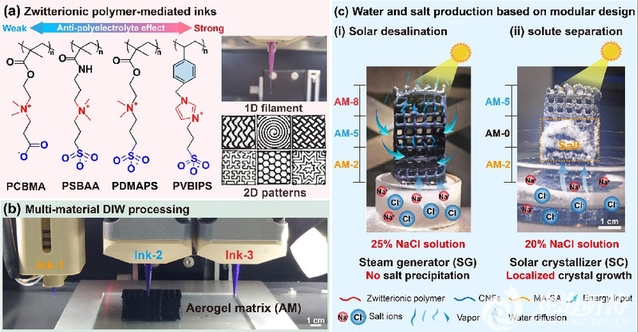
The photothermal inks comprise both fixed and tunable components. The fixed component consists of cellulose nanofibrils (CNFs), methacrylated sodium alginate (MA-SA), and carbon nanotubes (CNTs), while the tunable component is a zwitterionic prepolymer with adjustable concentration (e.g., PDMAPS). This formulation design synergistically improves ink printability and printing resolution, while enabling functional tunability.
Custom printing paths were designed for the three printing nozzles, and a multilayer stacking strategy was employed to construct the 3D architectures, yielding both flat and waffle-patterned surfaces. The waffle-patterned surface, together with a lattice framework featuring multiscale hierarchical pores, markedly increases the effective evaporation area and enables more efficient utilization of sunlight, airflow, and ambient energy. In seawater, the introduction of zwitterionic components induces a pronounced anti-polyelectrolyte effect, screening electrostatic interactions between polymer chains and exposing more ionic groups to interact with water molecules. The strong solvation of divalent cations further weakens hydrogen bonding in water and disrupts the original hydrogen-bond network. These synergistic effects increase the fraction of intermediate water and thereby accelerate the evaporation of the 3D SGs. Under 1 sun irradiation and an airflow of 2 m s−1, the 3D SGs attain the highest water evaporation rate of 17.9 kg m−2 h−1 in seawater, which is 10.5% higher than that in freshwater and over six times that under calm air. Even in 25% brine, evaporation rates of 6.6 kg m−2 h−1 are retained, demonstrating stable and efficient water evaporation over a broad salinity range (3.5−25%).
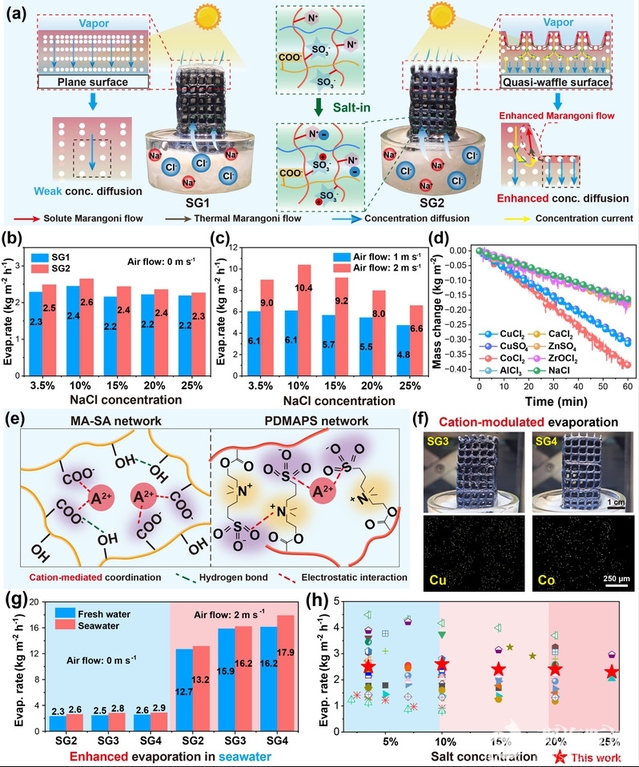
In contrast to the conventional focus on enhancing salt resistance, emerging directions such as solute separation, zero liquid discharge, and mineral recovery during seawater desalination have attracted growing attention. By leveraging multi-material printing and modular design, the photothermal matrix units can be reconfigured to achieve confined solute separation and salt harvesting, delivering a salt-collecting rate of 269.3 g m⁻² h⁻¹ in 20% brine. To assess practical applicability, this study further simulated the water evaporation and salt-collecting rates of the 3D SGs and 3D SCs in 7 major coastal cities and representative saltworks in China, highlighting the potential of multi-material-printed photothermal composites for high-efficiency clean water production, solute separation, and sea salt production.