Subduction is a key process that controls the redox state of the mantle, arc magma formation, and the evolution of Earth’s oxidation state. However, whether and how subducting slabs transport oxidized material to the sub-arc and back-arc mantle has long been intensely debated. Recently, Professor Li Sanzhong of Ocean University of China (OUC), together with Dr. Duan Wenyong, a postdoctoral researcher at Swiss Federal Institute of Technology (ETH Zurich), and other scholars from China and abroad, developed and applied a two-dimensional (2D) geodynamic–thermodynamic redox numerical model. Their study systematically revealed the mechanistic framework by which mantle oxidation in Mariana-type subduction zones is controlled by redox dynamics within the slab, and provided rigorous quantitative constraints. On March 4, the related results were published in an article entitled “Mantle oxidation influenced by reduction-oxidation budget of Mariana-type subduction zones” in Nature Geoscience, offering key quantitative constraints and theoretical insights for understanding subduction-related mantle oxidation and the long-term oxidation of Earth’s mantle in the context of modern plate tectonics.
Dr. Duan Wenyong of ETH Zurich is the first author of the paper, and Professor Li Sanzhong of OUC is the corresponding author. The study was conducted by 6 institutions, including OUC, ETH Zurich, and Laoshan Laboratory, among others. In addition, Professor Li Sanzhong and Dr. Duan Wenyong were invited by the editors of Nature Geoscience to write a Research Briefing entitled “Modelling reveals redox budget transfer in Mariana-type subduction systems”.
Substantial research has shown that magmatic systems in sub-arc and back-arc settings generally exhibit higher oxidation states than mid-ocean ridge basalts (MORB), yet the mechanisms responsible remain highly debated. Therefore, a quantitative assessment of the redox budget (RB) contributed by different slab units across depths is called for.
Previous studies have largely relied on zero-dimensional (0D) or one-dimensional (1D) thermodynamic models. Such approaches are inadequate to effectively capture the continuously varying pressure–temperature structure of subducting slabs in two-dimensional space, nor can they quantitatively describe the complex migration and interaction of fluids and melts among different lithologies and their combined effects on redox state. Numerical tools for quantitatively constraining redox processes in slab-mantle systems within a two-dimensional framework have still been lacking.
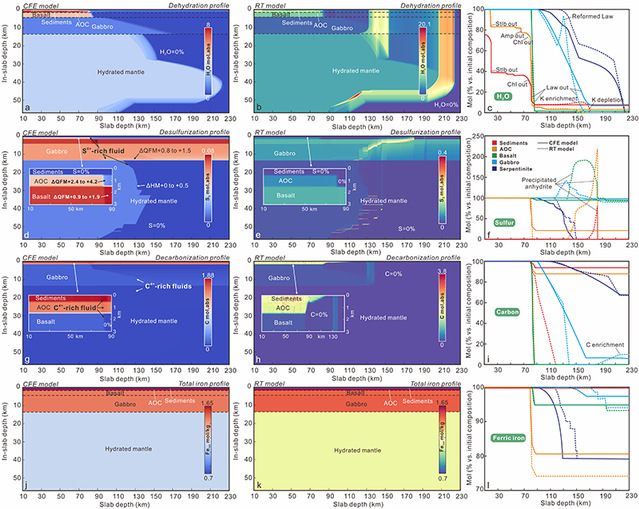
To address these issues, the research team selected the Mariana-type subduction zone, a representative example of modern plate tectonic systems, for systematic numerical simulation. The study developed a 2D geodynamic–thermodynamic redox numerical model and introduced two endmember scenarios under open-system conditions; using this framework, the team quantitatively characterized dehydration, desulfurization, decarbonization, and melting processes during subduction, as well as their redox mechanisms, in different lithological units within the subducting slab and at its base. The study is the first to systematically assess the contributions of different lithological units across depths to mantle oxidation and the efficiency of their transfer on a two-dimensional scale.
The study found that, at sub-arc depths, redox reactions involving sulfides and ferric ions occur in the weakly serpentinized mantles at the base of the slab and in the altered oceanic crust at the top of the slab, releasing highly oxidized sulfate-rich fluids. This is the primary mechanism driving sub-arc mantle oxidation.
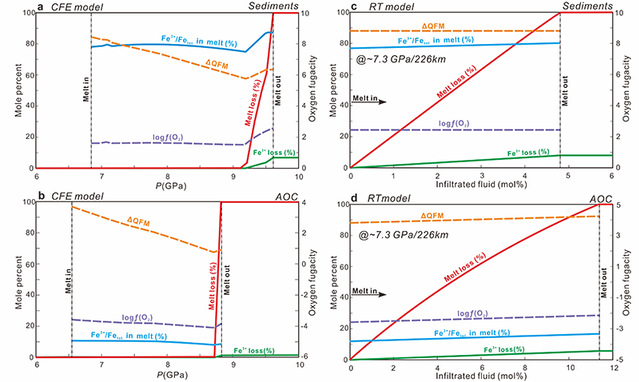
At greater depths beneath the back-arc, partial melting of slab sediments generates highly oxidized Fe³⁺-rich melts, which play a dominant role in the back-arc mantle and back-arc basin magma oxidation.
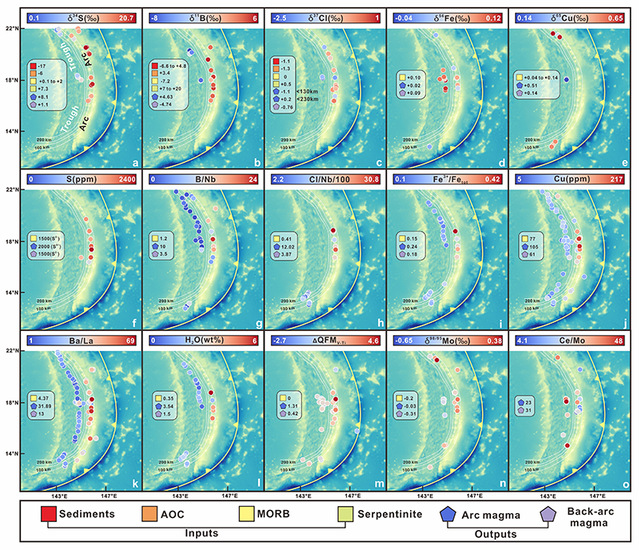
The study also compiled nearly 2,000 sets of magmatic geochemical data from the Mariana arc and back-arc region, covering 15 redox- and fluid/melt-related tracers. The results show that arc magmas generally display sulfur-related high oxidation states and strong fluid input signatures, whereas back-arc magmas exhibit moderate to weak sulfur-independent oxidation, lack clear fluid signatures, and instead exhibit melt signatures. These observations are highly consistent with the model prediction that sub-arc oxidation is mainly controlled by fluid-driven desulfurization, whereas back-arc oxidation is mainly controlled by melts, thereby independently supporting the reliability of the model.
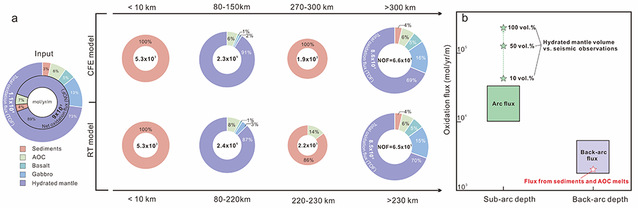
Quantitative calculations further indicate that only about 1/4 to 1/3 of the net redox-budget flux is released during arc-related stages, and the remaining ~70% is transported into the deep mantle with the subduction slab, which may influence the long-term oxidation evolution of the mantle.
This study extends the calculation of redox processes from earlier 0D and 1D thermodynamic models to a 2D geodynamic-thermodynamic numerical framework, marking an important advance from qualitative interpretation to quantitative analysis. The results indicate that, since the rise of modern plate tectonics, melt-fluid processes in Mariana-type subduction zones have been a key mechanism that drives the oxidation of the mantle wedge. This mechanism not only helps explain the generally high oxidation states of incipient arc and back-arc magmas but may also provide a geodynamic framework and quantitative assessment method for understanding major oxidation events in Earth’s history and the evolution of oxygenation on the Earth’s surface.
Several important questions remain to be addressed for further studies. Firstly, whether the mantle-wedge oxidation mechanism identified in Mariana-type subduction zones is globally applicable remains to be tested; different types of subduction zones may produce different redox effects on the mantle, and quantitative constraints on subduction-related redox budgets are still needed at the global scale. Secondly, whether subduction can continuously drive mantle oxidation over the geological timescale also requires a quantitative assessment in combination with subduction intensity and slab-fluid characteristics in different geological periods. In addition, both slab-derived melt-fluid processes and late-stage crystallization and differentiation of arc magmas may affect the oxidation state of felsic continental crust, but their relative contributions still require detailed quantitative calculation.