On November 25, 2025, Associate Professor Sun Xueshi from Professor Wang Houjie’s team at the College of Marine Geosciences at Ocean University of China (OUC) published their latest findings in Nature Communications in an article entitled “Global patterns and drivers of nitrogen isotope signal in modern marine sediments”. The study systematically analyzes the spatiotemporal evolution of nitrogen isotopes in modern marine sediments, pointing out that on centennial timescales, human activities and climate change are reshaping the marine nitrogen cycle with unprecedented intensity.
Nitrogen is a key nutrient that sustains marine life. The biogeochemical processes of nitrogen, such as nitrogen fixation, assimilation, nitrification, and nitrogen loss, regulate primary productivity in the surface ocean, thereby influencing the global marine carbon cycle and climate system. The stable nitrogen isotope signal preserved in marine sediments, δ15N, contains important biogeochemical information. As particulate matter and organic carbon subsided, this signal can be archived over long timescales, providing a unique perspective for tracing the past changes in marine nitrogen cycling and environmental conditions. However, due to limited ocean observations and the spatiotemporal heterogeneity of sedimentary nitrogen isotopes, a systematic understanding of the centennial-scale patterns, trends, and drivers of marine nitrogen cycling remains lacking.
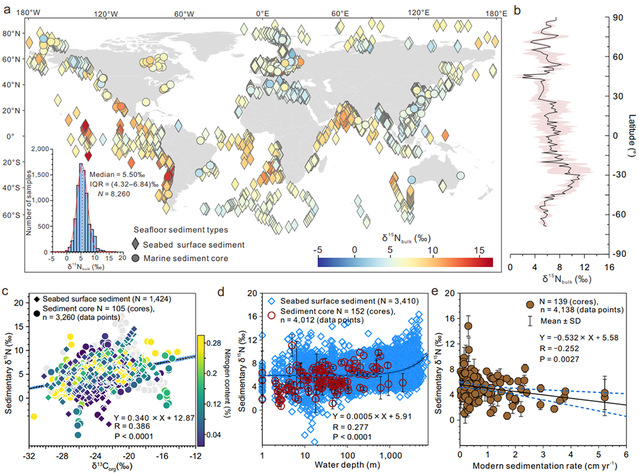
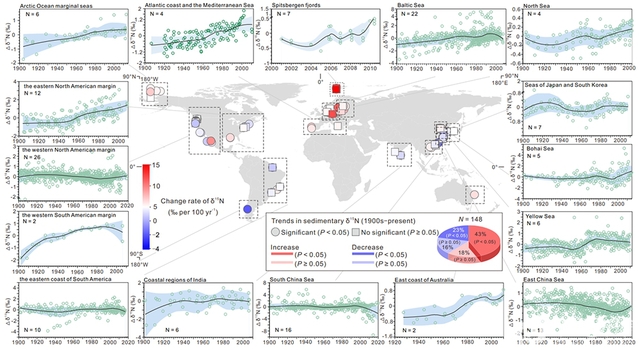
In this study, the researchers compiled δ15N data from global surface seafloor sediments and from sediment cores spanning the past century, integrating factors such as primary productivity, terrigenous inputs, and sedimentary settings, and reconstructed centennial-scale changes in marine nitrogen cycling and the underlying drivers. The results show pronounced latitudinal gradients and strong regional heterogeneity in sedimentary δ15N. At the global scale, variations in δ15N largely reflect nitrogen utilization and organic nitrogen production in marine ecosystems. In most sediment cores, δ15N values show sustained increases, which are associated with enhanced riverine nitrogen inputs, elevated primary productivity, and intensified denitrification. However, in estuarine and coastal regions strongly influenced by terrigenous inputs, changes in the sedimentary nitrogen pool appear to be controlled more by river-delivered, low-δ15N refractory organic carbon, which may obscure signals related to marine nitrogen utilization.