On November 17, 2025, researchers from the State Key Laboratory of Ocean Dynamics-Physical Environment and Intelligent Sensing at Ocean University of China (OUC) published an article entitled “Southward shift of the Antarctic Circumpolar Current upstream of Drake Passage maintains a stable circumpolar transport” in Nature Climate Change. The study demonstrated that over the past three decades, under global warming, uneven warming between high and low latitudes has led to an acceleration of zonal flow in the northern Southern Ocean. At the same time, the northern boundary of the Antarctic Circumpolar Current (ACC) has migrated southwards, redirecting the intensified flow into the subtropical Southern Ocean supergyre, thereby maintaining a stable ACC transport.
As the strongest oceanic current on Earth, the ACC links the Pacific, Atlantic, and Indian oceans, facilitating the exchange of mass and energy between them. However, observations over the past 30 years have revealed an apparent paradox: while the upper-level zonal flow in the northern Southern Ocean has intensified markedly, the ACC transport through the Drake Passage (DP) has remained stable.
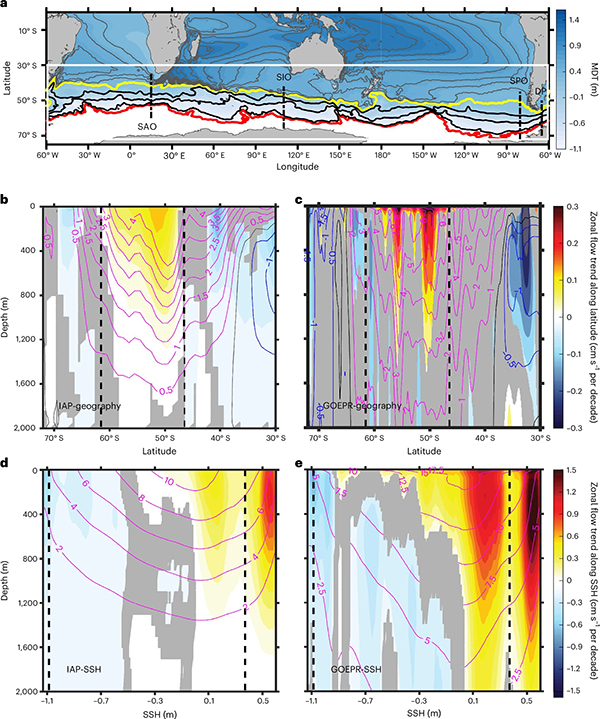
Based on the satellite altimetry data, ocean observation data, and numerical reanalysis from 1993 to 2022, the study is the first to reveal the mechanisms that maintain ACC transport stability from the perspective of large-scale circulation redistribution. Previous works have shown a significant acceleration of zonal flow in the northern Southern Ocean in the recent period. However, according to this study, the enhanced transport does not feed into the mainstream of ACC; instead, owing to a persistent southward shift of the Northern Boundary (NB) of ACC, particularly in the southeast Pacific upstream of DP (migration rate reaches up to 1.1° per decade), it is effectively diverted into the Southern Ocean supergyre north of the ACC. This large-scale redirection mechanism, triggered by changes in the thermodynamic structure and realized through the migration of the boundary, effectively “shields” the ACC transport from the impact of the accelerated flows in the northern region of the Southern Ocean, thereby maintaining an overall stability of its circumpolar current. This mechanism both resolves the long-standing puzzle of ACC transport stability and highlights the dynamically coupled relationship between the ACC and the subtropical gyre system.
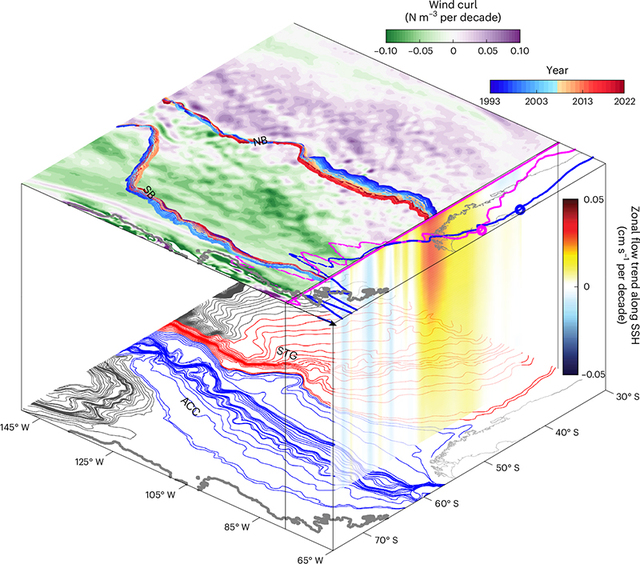
This study goes beyond previous studies of ACC stability that focus primarily on mesoscale eddy dissipation and proposes a new viewpoint centered on large-scale circulation redirection. It provides a fresh perspective on Southern Ocean circulation and its role in the Earth system, and is of great scientific importance for more accurate prediction of future changes in the Southern Ocean and its global impacts.