On December 1, 2025, the research team led by Associate Professor Chen Jingwei from the School of Materials Science and Engineering at Ocean University of China (OUC) has made new progress in optical-thermal regulating electrochromic smart windows. Their research findings have been published in Nature Communications and ACS Energy Letters, and they also published a review article in Nature Reviews Clean Technology.
Buildings are responsible for about 40% of the total energy consumption in modern society, and windows, as the key interface for light and heat exchange, are the least energy-efficient components in buildings. Smart windows that dynamically regulate light and heat transfer offer a promising route to improving building energy efficiency. Among various smart-window technologies, electrochromic windows based on reversible metal electrodeposition (RME) feature simple device architectures, broadband optical modulation, and nearly color neutrality. However, the limited stability of the electrode/electrolyte interface undermines the plating/stripping dynamics and the chemical and electrochemical stability of these devices, posing challenges for their durability and scalable production. Developing fast-switching, high-performance, biocompatible, and environmentally friendly electrolytes has become a key bottleneck for translating this technology into practical applications.
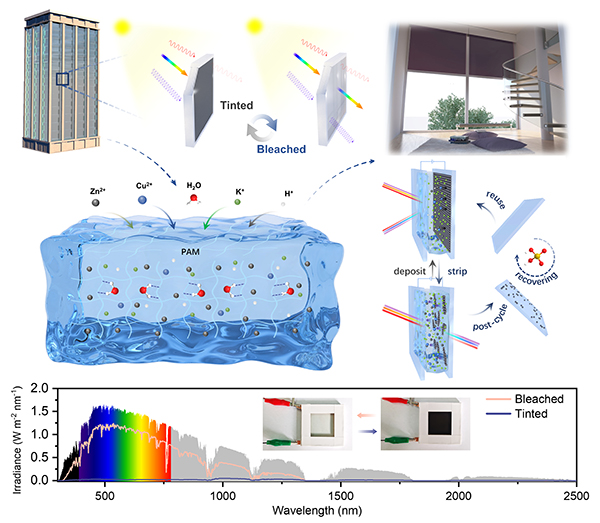
Addressing these challenges, the research group, in collaboration with Professor Wang Huanlei at OUC and the team led by Academician Lee Pooi See at Nanyang Technological University, designed a quasi-solid-state hydrogel electrolyte composed of Cu/Zn dual-metal salts and hydrophilic polyacrylamide (PAM) networks. By optimizing the Cu:Zn ratio and pH of the electrolyte, they achieved a highly reversible CuZn electroplating/stripping process. The resulting devices exhibit a large optical transmittance modulation of 78%, excellent cycling stability with over 3,000 switching cycles (with a retention rate of over 90%), and fast coloration/bleaching switching kinetics. In addition, the hydrogel electrolyte effectively inhibits strong hydrogen bonds among water molecules, thereby enhancing the anti-freezing capability down to −20°C and enabling leakage-free operation, extended memory effect, patternability, and efficient thermal insulation in recyclable quasi-solid-state dynamic windows. These devices manifest 18% to 33% energy saving across different climatic regions, demonstrating both cost-effectiveness and durability. The related findings were published in Nature Communications in an article entitled “Recyclable quasi-solid-state dynamic windows via reversible dual-metal electrodeposition for building energy modulation”, with Xu Bing, a PhD candidate enrolled in 2023 in the Marine Materials Science and Engineering Program at the School of Materials Science and Engineering, as the first author, and OUC serving as the leading corresponding institution.
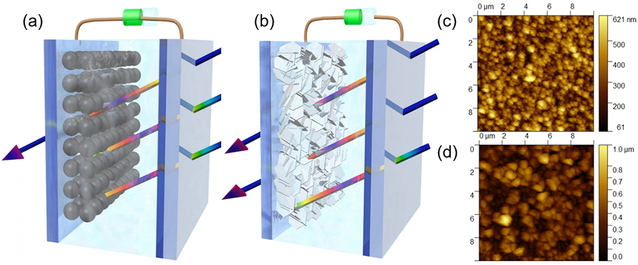
In their earlier work, the group also developed a smart-window technology based on CuZn alloy nanoparticles via reversible alloy electrodeposition (CuZn-RAE). By taking advantage of the higher redox potential of Cu²⁺ and its strong zincophilicity, they realized a gradient deposition mechanism in which Cu nucleated first to guide the nucleation of Zn. This strategy effectively reduced the activation energy for metal plating (19.2 kJ mol-1), yielding uniform spherical nanoparticles, a large optical transmittance modulation of 82%, and color neutrality, thus significantly improving the switching speed, stability (with a retention rate of over 92% after 1,400 cycles), and optical-thermal regulation performance of the smart windows. These results were reported in ACS Energy Letters in an article entitled “Color-Neutral Smart Window Enabled by Gradient Reversible Alloy Deposition”, with Zhang Yingxin, a master’s student enrolled in 2022 in the Materials Engineering Program at the School of Materials Science and Engineering, as the first author, and OUC as the leading corresponding institution.
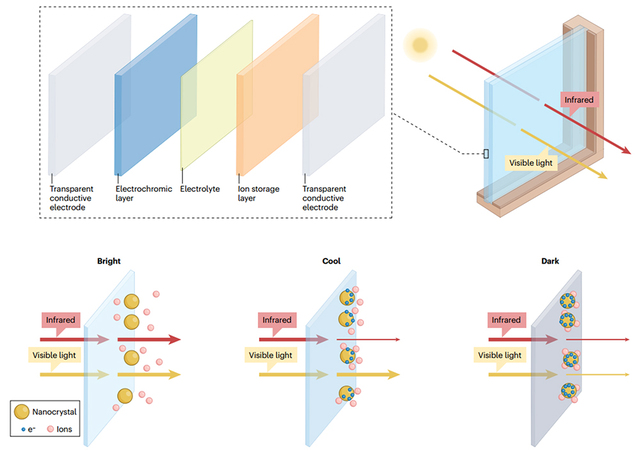
Building on their sustained research into optical-thermal regulating electrochromic smart windows, the group, together with collaborators from Shandong University, the University of Alberta, and other institutions, provided a comprehensive discussion of the working modes, assembly protocols, and implementation of inorganic electrochromic smart windows (ESWs). This collaborative review systematically examined the relationships between ESW energy efficiency, material selection, electrochemical processes, and their optical and thermal regulation properties. They highlighted the advantages of utilizing dual-band regulation and reversible metal-deposition technologies in inorganic ESWs, emphasizing the importance of improving cost-effectiveness, scalability, and long-term durability. The review article, entitled “Inorganic electrochromic smart windows for advancing building energy efficiency”, was published in Nature Reviews Clean Technology, with OUC serving as the corresponding institution.