On November 20, 2025, the research team led by Professor Chen Xianyao from the Frontiers Science Center for Deep Ocean Multispheres and Earth System and the Key Laboratory of Physical Oceanography at Ocean University of China (OUC) published their latest findings in Science Advances in an article entitled “Deep Arctic Ocean warming enhanced by heat transferred from deep Atlantic”. This study is the first to demonstrate that rapid warming of deep waters in the Greenland Basin has already exerted a significant impact on the deep Arctic Ocean.
The deep Arctic Ocean comprises two major basins, the Amerasian Basin (AB) and the Eurasian Basin (EB), which are separated by the Lomonosov Ridge (LR). Hydrographic observations since the 1990s indicate that the deep and bottom Arctic Ocean has been gradually warming. However, sea ice severely limits observations in the Arctic Ocean, hindering a systematic understanding of variability in the deep Arctic Ocean and constraining accurate assessment of the mechanisms driving this warming.
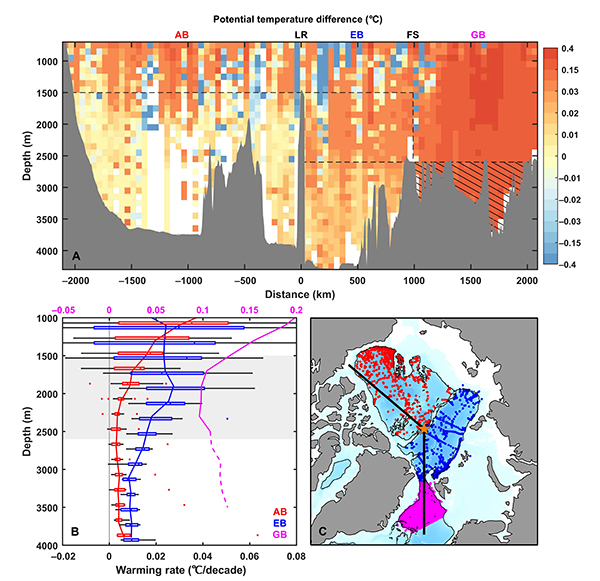
Based on observational data, the team examined the rate and spatial characteristics of deep Arctic Ocean warming. They found pronounced spatial contrasts below the depth of the LR (1,500m), particularly between 2,000 and 2,600m: warming in the EB is much faster than in the AB. Specifically, the EB deep waters warm at 0.020 ± 0.012°C/decade, more than five times faster than the AB deep waters at the same depth (0.003 ± 0.003°C/decade).
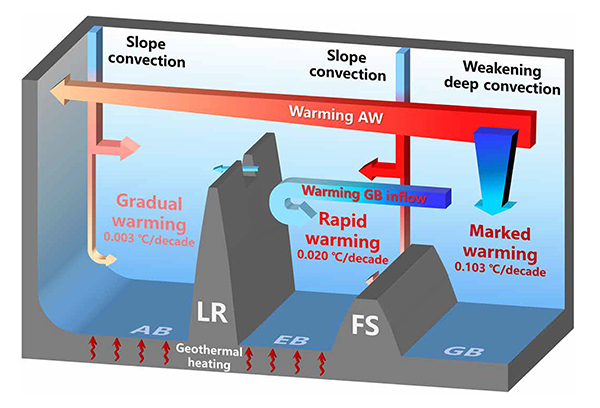
Using an idealized Arctic Ocean circulation model, the team found that the conventional mechanisms, such as slope convection and geothermal heating from the seafloor, cannot fully explain the rapid warming of deep waters in the EB or the pronounced warming rate contrast between the EB and the AB. However, when the warming signal of deep waters in the Greenland Basin (GB) was incorporated into the model, the simulated warming rates became consistent with the observations. The results indicate that sustained warming of deep GB waters is a major driver of rapid warming in the deep EB waters: the warming signal is advected into the EB through the Fram Strait, enhancing warming in the EB waters. At the same time, the LR acts as a topographic barrier that prevents most of this warming signal from spreading into the AB, while an approximately 20km-wide, 2000m-deep sill in the central part of the ridge may still allow some of the warming signal to enter the AB. The complex bottom topography of the deep Arctic Ocean, together with oceanic interactions between basins, shapes the pattern of continuous deep Arctic Ocean warming, with warming in the EB significantly outpacing that in the AB. These findings provide key mechanistic support for a more accurate understanding and assessment of the deep Arctic Ocean heat budget and its climatic impacts.