On January 8, 2026, a research team led by Professor Zhao Wei from the Key Laboratory of Physical Oceanography at Ocean University of China (OUC) published their latest findings in Nature Geoscience. In an article entitled “Weak self-induced cooling of tropical cyclones amid fast sea surface warming”, the team systematically quantified cyclone-induced inner-core sea surface cooling using in situ observation data and revealed a pronounced cold bias in satellite remote-sensing products and climate models.
The ocean is the energy source of tropical cyclones (TCs). Inner-core sea surface temperature (SST) and cyclone-induced cooling are key factors controlling storm intensity, and are crucial for short-term intensity forecasts and long-term projections of TCs. However, because in situ observations in the inner-core region are extremely difficult and microwave satellite remote-sensing systems are strongly affected by heavy rainfall, observations of inner-core SST remain very limited. As a result, our current scientific understanding of the magnitude, characteristics, and long-term trends of inner-core cooling remains highly incomplete.
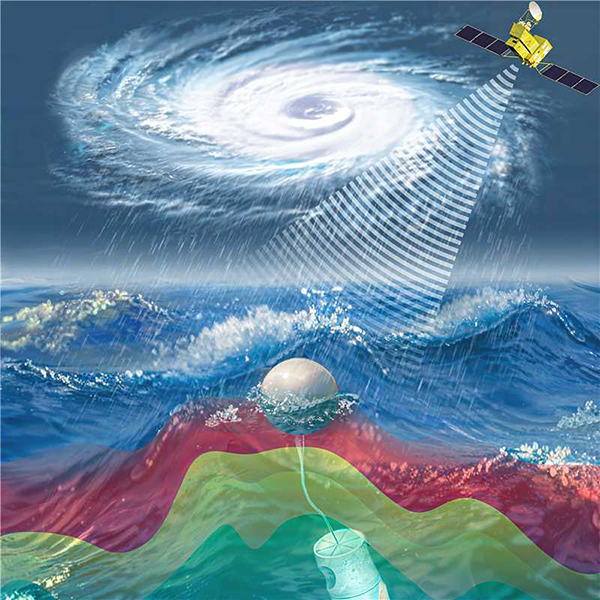
Launched in 1979, the Global Drifter Program aims to maintain a network of about 1,300 surface drifters worldwide, providing high-resolution observations of sea surface currents and temperatures. Over the past several decades, these in situ observations have provided essential data for studies of upper-ocean circulation dynamics. The team found that, as drifters move with surface currents, they can effectively record storm-local SST and inner-core cooling in TC active regions. By accurately matching the space-time positions of global surface drifters and TCs, the researchers showed that drifters have captured 77% of global Category 1–5 TCs over the past three decades. This in situ dataset provides more than 100 times as many inner-core observations as traditional moored buoys and other observational platforms, offering a solid basis for statistically quantifying instantaneous inner-core cooling on weather timescales and its long-term evolution on climate timescales.
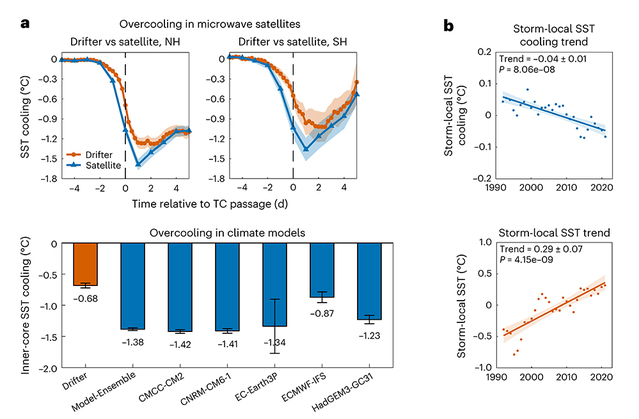
Using global surface drifter observations, the research team quantified an average inner-core SST cooling of −0.68 ± 0.04 °C in storm-affected areas on weather timescales. This represents the first global-scale characterization of the magnitude and spatial pattern of inner-core SST cooling based on in situ observations since the concept of cyclone-induced sea surface cooling was proposed in the 1950s. By comparison, microwave satellite observations yield an average inner-core SST cooling of −1.05 ± 0.06 °C, implying a pronounced cold bias that overestimates the inner-core cooling by about 55%; a similar cold bias is found in state-of-the-art climate models (−1.38 ± 0.02 °C, an overestimation of about 100%). Sensitivity tests show that correcting this cold bias can reduce the mean error in simulated TC intensity by about 40%, indicating that the cold bias is one of the key contributors to the systematic underestimation of TC intensity in current coupled climate models. On climate timescales, the team found that although global warming has strengthened upper-ocean stratification and enhanced inner-core SST cooling, storm-local SST beneath TCs is still warming rapidly at 0.29±0.07℃ per decade—about twice the average warming rate of SST in TC-active tropical oceans. This provides direct observational evidence that ocean warming is fueling the intensification of TCs. The discovery implies that TCs are more likely to occur over ocean regions that are warming faster than the tropical average, probably because warming in the atmosphere is relatively uniform, whereas the faster-warming ocean regions are more favorable for sustaining deep convection and thus for generating strong TCs. These results provide a key observational benchmark for weather and climate models, and suggest that existing prediction systems may underestimate both the intensity and frequency of future major TCs, as well as the associated risks of extreme rainfall, elevated sea levels, and socio-economic losses.
Aliénor Lavergne, Editor-in-Chief of Nature Geoscience, spoke highly of this research, describing it as “reshaping our understanding of ocean–atmosphere interactions under climate change”. To further promote the work, Katharine Wrighton, Head of the Reviews Cross-Journal Editorial Team at Springer Nature, invited the authors to write a Research Briefing entitled “Cyclone-induced cooling is weaker than suggested by previous estimates”, which was published alongside the research article. In the Research Briefing, Dr Noel G. Brizuela from Max Planck Institute for Meteorology in Germany commended the study, noting that the authors “have used data from the Global Drifter Program to quantify robust trends in sea surface temperature cooling beneath tropical cyclones, providing timely insight into key and fast-changing weather–climate interactions”.