Recently, the research team led by Professor Chen Shougang from the School of Materials Science and Engineering at Ocean University of China (OUC) published their latest findings in Engineering in a paper entitled “Template-Directed Growth of a 3D Hierarchical Structure of Well-Aligned Bimetallic MOF Arrays for High-Efficiency Electrocatalytic Air Sterilization”. Applying a biomimetic strategy, the team designed a new electrode material that rapidly and efficiently inactivates microorganisms in flowing air under a low voltage, offering an innovative solution for air sterilization in confined spaces.
Indoor air quality is directly related to public health. According to a WHO report, air pollution levels in confined spaces can reach 5-10 times those outdoors, and around 4% of global diseases are associated with indoor air pollution. However, existing technologies such as ventilation, adsorption, and photocatalysis suffer from limitations in efficiency, stability, or safety, and thus cannot fully meet the demand for rapid, energy-efficient removal of pathogenic microorganisms from the air.
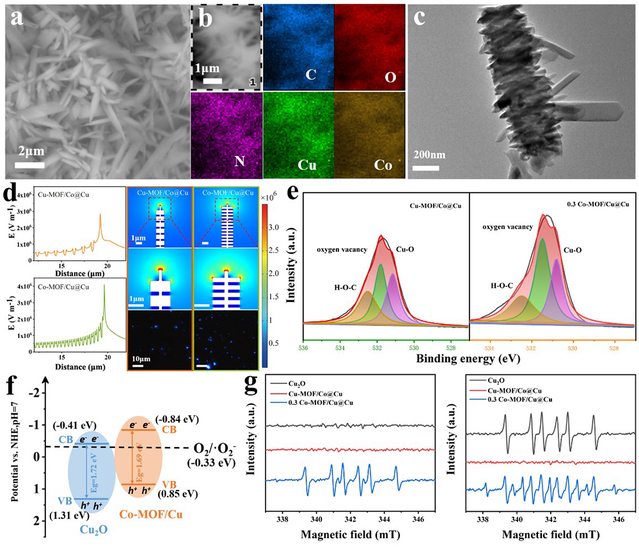
To address this challenge, inspired by natural structures, the research team adopted a template-directed growth strategy to fabricate a 3D hierarchical superstructure of well-aligned cobalt-copper bimetallic metal–organic framework (Co-MOF/Cu@Cu) arrays on a copper substrate. This distinctive architecture affords a large specific surface area and abundant surface-active sites, while exhibiting excellent stability. Experimental results show that when the air flows at 1.5m/s through the electrode under an AC voltage of 12-24V, the contact time is as short as 0.003s and the bacterial inactivation efficiency exceeds 99%; at 24V, the sterilization efficiency reaches 99.5%. Combining experiments and simulations, the team systematically revealed that the high sterilization performance stems from its synergistic mechanism of electroporation and reactive oxygen species (ROS). The unique tip-and-edge morphology significantly enhances the local electric field, rapidly disrupting the bacterial membrane via electroporation. Meanwhile, the external electric field drives the electrocatalytic reduction of oxygen on the material surface, generating reactive oxygen free radicals (exogenous ROS), which further interfere with bacterial metabolism and trigger the production of exogenous ROS, ultimately causing complete bacterial destruction through both physical and chemical methods.
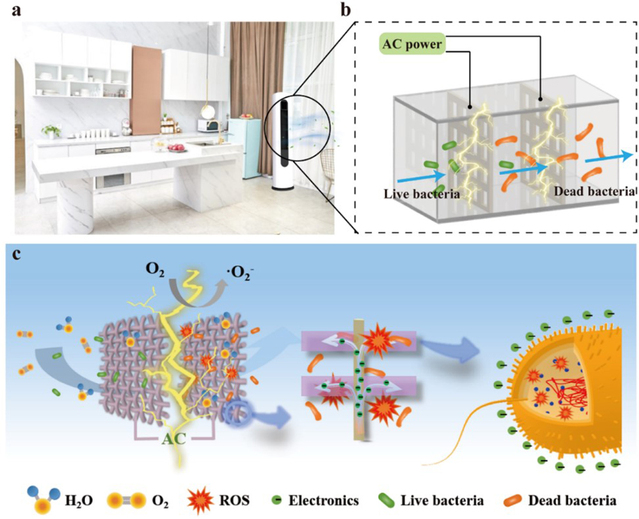
The electrode material can be directly used as a filter module integrated into existing air-conditioning and fresh-air systems. Its modular design, low operating voltage, and instant high-efficiency sterilization endow the system with significant energy-saving potential and ease of engineering implementation, providing a reliable technical route for the real-time, online purification of high-flow air.
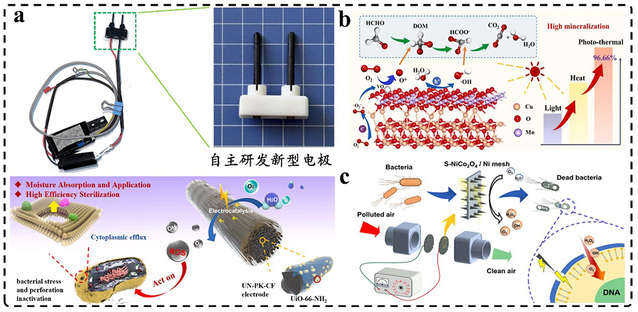
In recent years, guided by a biomimetic design concept, the team has regulated the tip-discharge effect of conductive nanowire (NW) arrays and combined photocatalysis and electrocatalysis degradation mechanisms to achieve efficient removal of bacteria, viruses, and odor molecules in high-flow air or water environments. In close collaboration with Hisense Home Appliances Group, the team has successfully developed electrode materials with sterilization and deodorization functions and demonstrated their performance in practical application scenarios, achieving important breakthroughs in both purification efficiency and energy efficiency.