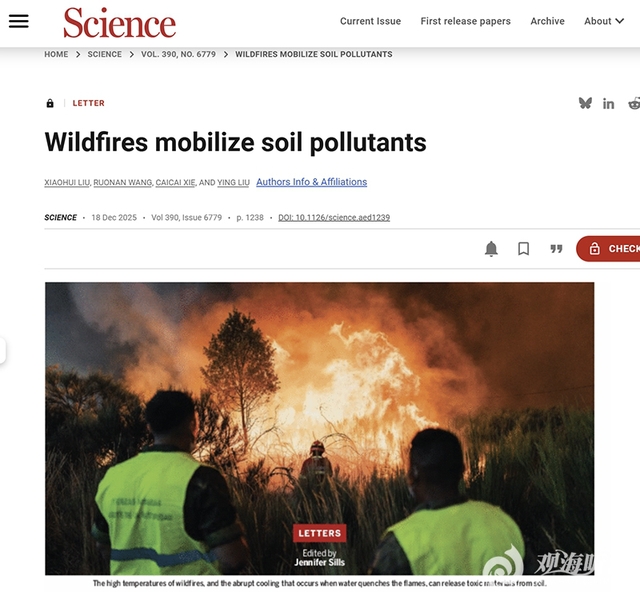
On December 18, an article entitled “Wildfires mobilize soil pollutants” was published in the Letter Section of Science, with Ocean University of China (OUC) as the leading institution and Associate Professor Liu Xiaohui from the College of Environmental Science and Engineering as the first author.
The article focuses on the rerelease of toxic pollutants in the soil, pointing out that climate-amplified wildfires have evolved from ecological disturbances to potent global contamination vectors. Long recognized for direct ecosystem harm and greenhouse gas emissions, wildfires now act as unregulated transporters, mobilizing legacy and emerging pollutants from terrestrial systems to the atmosphere. Proactive, science-based policies are essential to mitigate this growing threat to planetary and human health.
Under extreme temperatures, heat not only releases organic pollutants such as brominated flame retardants and per- and polyfluoroalkyl substances (PFAS) through thermal desorption but also causes incomplete combustion, thermally degrading the pollutants into more mobile products. Simultaneously, elevated temperatures alter the chemical speciation of heavy metals and their binding mechanisms with soil particles, releasing those once bound within clay mineral lattices and converting them into bioavailable fine particles that are dispersed by smoke plumes and transported over long distances. Specifically, the extreme temperatures generated by wildfires volatilize or aerosolize soil-bound mercury and polycyclic aromatic hydrocarbons (PAHs), which are then carried in smoke plumes, transported hundreds of kilometers, and deposited, markedly increasing contaminant loads in downwind regions.
Firefighting water rapidly quenches burned soil, inducing thermal shock. This shock fractures soil architecture and expands reactive surfaces, facilitating the oxidation of elements such as chromium into more toxic forms. Highly elevated concentrations of carcinogenic hexavalent chromium were detected in air samples collected from the affected areas after the Los Angeles wildfires. In addition, at the moment water contacts the super-heated soil, a massive amount of soil ash and aerosol particles are generated. Ash-laden aerosols form, evolving into efficient long-range transporters of heavy metals and toxic vapors that threaten respiratory health.
Wildfires release large quantities of long-sequestered soil pollutants into the atmosphere, which–after atmospheric deposition–reenter terrestrial and aquatic systems, disrupting ecosystem function. Deposited contaminants degrade soil quality and impair plant root function, leading to growth suppression and mortality. Atmospheric deposition of fire-derived mercury markedly increases watershed mercury loads, causing a rapid rise in mercury concentrations in fish. These pollutants enter aquatic systems, accumulating to toxic levels that disrupt trophic cascades and energy flow. As fire frequency increases, contaminants move up food webs, amplifying biomagnification and constituting a systemic threat to ecosystems.
International agreements such as the Minamata Convention on Mercury and the Stockholm Convention on Persistent Organic Pollutants overlook the secondary release of contaminants during wildfires. Addressing this gap requires enhancing global atmospheric monitoring networks to include specific wildfire smoke tracers. Post-fire environmental assessments should assess not only traditional metrics such as burned area and fine particulate matter but also the release flux and chemical speciation of toxins in soil, ash, and water. Climate-chemistry models should integrate soil pollution inventories, fire behavior, and meteorological data to dynamically predict pollutant rerelease and transport pathways.