On May 28, Nature published online a new research article entitled “Air pollution modulates trends and variability of the global methane budget”. The study is led by Associate Professor Zhao Yuanhong from the College of Oceanic and Atmospheric Sciences at OUC, with Associate Professor Zheng Bo from Tsinghua Shenzhen International Graduate School serving as the corresponding author. The team also includes collaborators from the Laboratory for Climate and Environmental Sciences in France and the Jülich Research Centre in Germany, as well as graduate students from OUC and Tsinghua Shenzhen International Graduate School.
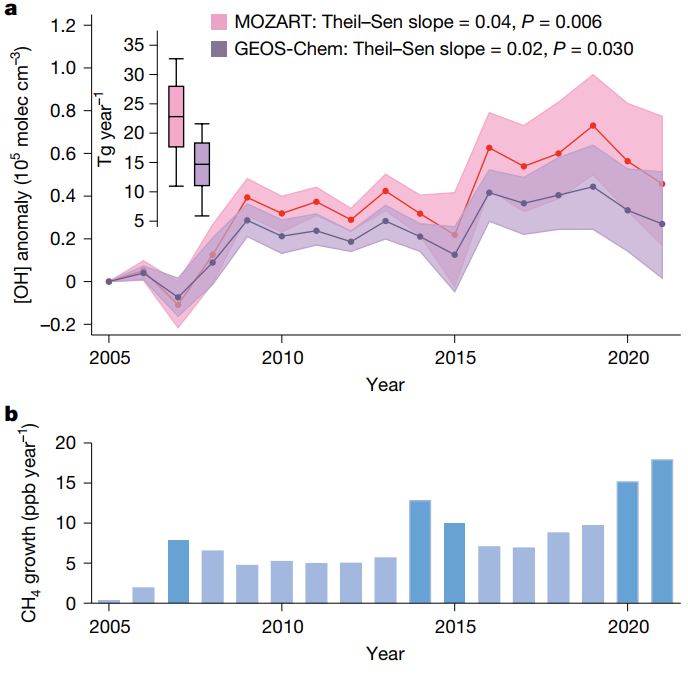
As the second-largest greenhouse gas, the rapid rise of global methane levels has become a major driver of climate warming. Accurately understanding methane sources and sinks and their regulating mechanisms is crucial for effective climate mitigation. The hydroxyl radical (OH) is the dominant atmospheric sink for methane, yet its concentration levels and spatiotemporal trends remain poorly constrained, and the key factors controlling global OH variability are still not well understood. To address this challenge, the team developed an integrated observation-driven and model-driven global quantitative characterization system for atmospheric OH radicals, which quantifies the impacts of major air pollutants such as ozone (O₃) and carbon monoxide (CO) on OH and the methane sink during 2005–2021. The results reveal the key mechanisms by which air pollutants regulate OH concentrations and their spatiotemporal variations, thereby modulating the global methane source–sink budget.

The short lifetime of around one second and complex chemical reactivity make OH radicals difficult to observe directly over large regions, while conventional atmospheric chemistry models struggle to accurately simulate the global distribution of OH and quantify its impact on the methane sink. In response, the team developed an integrated analytical framework that combines multi-source observational datasets with an atmospheric chemistry box model. Satellite remote-sensing and reanalysis products are used to obtain the spatiotemporal patterns of atmospheric constituents. A box model with detailed chemical mechanisms is employed at each global grid cell to characterize the response surfaces of OH to changes in different atmospheric components. This framework enables precise quantification of the full response chain linking atmospheric composition, OH radicals and methane.