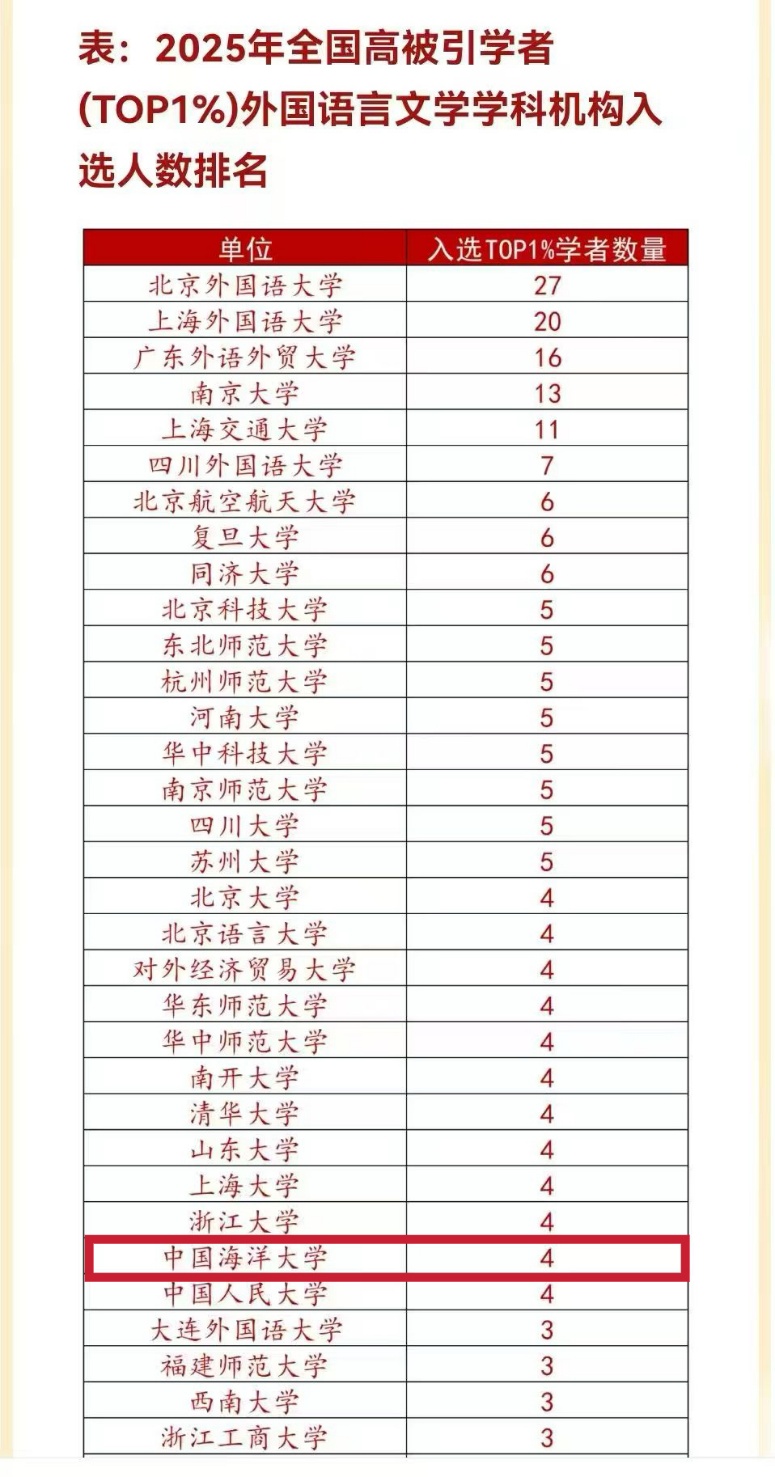
Recently, the China National Knowledge Infrastructure (CNKI), through its China Scientific Literature Evaluation and Metrics Research Center, officially released the 2025 National Highly Cited Scholars list. A total of nine scholars from the College of Foreign Languages, Ocean University of China, were presented in the list. Notably, in the discipline of Foreign Languages and Literature, the College ranks tied for 18th nationwide in terms of the number of scholars listed in the Top 1%, underscoring its strong momentum in producing high-quality research and its growing academic influence in the field.
The CNKI Highly Cited Scholars selection is based on the Paper Citation Standardized Index (PCSI) of papers published by scholars over the past decade. The evaluation identifies scholars nationwide who have demonstrated outstanding research productivity and academic impact. Among approximately 17 million authors who published papers in the past ten years, only 3.59 million whose publications achieved a PCSI above the average value (1.65) were eligible for consideration. Ultimately, approximately 120,000 scholars were selected nationwide, including roughly 30,000 Top 1% scholars and 90,000 Top 5% scholars, reflecting the highly competitive nature of the selection process. According to relevant statistics, 611 scholars in Foreign Languages and Literature were selected in total, with 329 named to the Top 1% and 282 to the Top 5%.
The selected scholars from the College of Foreign Languages in Ocean University of China represent a strong and well-balanced academic cohort. Gao Yuxia, Ren Dongsheng, Yang Lianrui, and Yu Guodong (listed in alphabetical order by surname) were named to the 2025 National Highly Cited Scholars Top 1%, while Chen Shifa, He Aijun, Wu Yaxin, Xu Derong, and Zhang Kai (listed in alphabetical order by surname) were named to the Top 5%. This recognition not only affirms the individual scholars’academic impact and research contributions but also highlights the College’s sustained strength and solid foundations across key research areas.
Looking ahead, the College of Foreign Languages will take this achievement as an opportunity to further strengthen organized research efforts and the cultivation of high-level academic outputs, continue advancing disciplinary development and faculty growth, and steadily enhance its capacity for research innovation and social service. These efforts will contribute to the University’s Double First-Class initiative and to the high-quality development of the discipline of Foreign Languages and Literature.